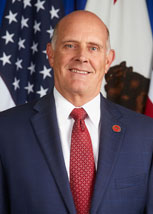
Kelly Seyarto’s public life runs through Murrieta City Hall, the fire service and, eventually, state office. He spent decades as a firefighter, retiring from the Los Angeles County Fire Department as a battalion chief, and served two separate stretches on the Murrieta City Council. The council selected him as mayor four times. He entered the State Assembly after the 2020 election and announced his candidacy for the State Senate in 2022, when Melissa Melendez could not seek reelection because of term limits. For Senate District 32 voters, the central facts of Seyarto’s career remain the long fire-service tenure and the repeated return to Murrieta government.
THE JOB BEFORE THE JOB
Born in La Puente on January 21, 1962, Seyarto grew up in Baldwin Park and La Verne. In 1981, he earned an associate degree in fire science from Mt. San Antonio College and began work as a paid reserve firefighter with the La Verne Fire Department. Two years later, he joined the Inglewood Fire Department.
Inglewood’s department was incorporated into the Los Angeles County Fire Department in 2000. Seyarto remained in the service until 2015, when he retired with the rank of battalion chief.
His education continued alongside that career. He received a bachelor’s degree in fire protection administration and technology from California State University, Los Angeles, in 1989. In 1996, he earned a Master of Public Administration from California State University, Long Beach. His degrees covered fire science, fire protection administration and technology, and public administration.
HOME GROUND
Seyarto was first elected to the Murrieta City Council in 1997. He served until 2006, then returned to the council in 2016. Those two non-consecutive stretches distinguish his local record from a single uninterrupted climb through offices.
Murrieta’s council selected him as mayor in 2000, 2003 and 2006. After his return to the council, it selected him again in 2019. The result was four separate turns as mayor, spread across nearly two decades rather than concentrated in one period.
That repeated service is the clearest local measure of his public career. Murrieta was not merely an address attached to a state candidate: it was the government in which he held office, left office, returned and again served as mayor. In 2020, the Riverside Division of the League of California Cities presented him with its Outstanding Public Service Award. Seyarto continues to live in Murrieta with his wife, Denise; they have three daughters.
THE JUMP
In 2020, Seyarto sought the 67th State Assembly District seat. He placed second among five candidates in the nonpartisan blanket primary, advancing to the November election against lawyer Jerry Carlos.
On November 3, Seyarto defeated Carlos with 60.02% of the vote. His Assembly term began on December 7, 2020. It was his first state office after years in the fire service and Murrieta government.
On January 3, 2022, Seyarto announced that he would run for the State Senate. The opening came because incumbent Melissa Melendez was ineligible to seek reelection under term limits. The chronology is compact: election to the Assembly in November 2020, the start of his term that December, and a Senate candidacy announced a little more than a year later.
THE POLICY SIGNATURE
Seyarto’s documented record here does not establish a signature law, budget fight, regulatory position or defining vote. It establishes something narrower: a public career concentrated in fire service and Murrieta municipal government, followed by the move to state office.
The interests most plainly present are those institutions themselves. Seyarto trained in fire science and fire administration, spent his professional career in fire departments, and retired as a battalion chief. In elected office, the recurring constituency is Murrieta, where he served two separate council tenures and four times as mayor.
The record does not show whether he converted those experiences into particular state legislation for firefighters, cities or public agencies. What voters can identify without speculation is the operating résumé he brought with him: county fire command, repeated selection by council colleagues to serve as mayor, and a return to local office before seeking seats in Sacramento.
- State Senate · Senate District 32 · 2022–present
- State Assembly · Assembly District 67 · 2020–
Kelly Seyarto’s public life runs through Murrieta City Hall, the fire service and, eventually, state office. He spent decades as a firefighter, retiring from the Los Angeles County Fire Department as a battalion chief, and served two separate stretches on the Murrieta City Council. The council selected him as mayor four times. He entered the State Assembly after the 2020 election and announced his candidacy for the State Senate in 2022, when Melissa Melendez could not seek reelection because of term limits. For Senate District 32 voters, the central facts of Seyarto’s career remain the long fire-service tenure and the repeated return to Murrieta government.
THE JOB BEFORE THE JOB
Born in La Puente on January 21, 1962, Seyarto grew up in Baldwin Park and La Verne. In 1981, he earned an associate degree in fire science from Mt. San Antonio College and began work as a paid reserve firefighter with the La Verne Fire Department. Two years later, he joined the Inglewood Fire Department.
Inglewood’s department was incorporated into the Los Angeles County Fire Department in 2000. Seyarto remained in the service until 2015, when he retired with the rank of battalion chief.
His education continued alongside that career. He received a bachelor’s degree in fire protection administration and technology from California State University, Los Angeles, in 1989. In 1996, he earned a Master of Public Administration from California State University, Long Beach. His degrees covered fire science, fire protection administration and technology, and public administration.
HOME GROUND
Seyarto was first elected to the Murrieta City Council in 1997. He served until 2006, then returned to the council in 2016. Those two non-consecutive stretches distinguish his local record from a single uninterrupted climb through offices.
Murrieta’s council selected him as mayor in 2000, 2003 and 2006. After his return to the council, it selected him again in 2019. The result was four separate turns as mayor, spread across nearly two decades rather than concentrated in one period.
That repeated service is the clearest local measure of his public career. Murrieta was not merely an address attached to a state candidate: it was the government in which he held office, left office, returned and again served as mayor. In 2020, the Riverside Division of the League of California Cities presented him with its Outstanding Public Service Award. Seyarto continues to live in Murrieta with his wife, Denise; they have three daughters.
THE JUMP
In 2020, Seyarto sought the 67th State Assembly District seat. He placed second among five candidates in the nonpartisan blanket primary, advancing to the November election against lawyer Jerry Carlos.
On November 3, Seyarto defeated Carlos with 60.02% of the vote. His Assembly term began on December 7, 2020. It was his first state office after years in the fire service and Murrieta government.
On January 3, 2022, Seyarto announced that he would run for the State Senate. The opening came because incumbent Melissa Melendez was ineligible to seek reelection under term limits. The chronology is compact: election to the Assembly in November 2020, the start of his term that December, and a Senate candidacy announced a little more than a year later.
THE POLICY SIGNATURE
Seyarto’s documented record here does not establish a signature law, budget fight, regulatory position or defining vote. It establishes something narrower: a public career concentrated in fire service and Murrieta municipal government, followed by the move to state office.
The interests most plainly present are those institutions themselves. Seyarto trained in fire science and fire administration, spent his professional career in fire departments, and retired as a battalion chief. In elected office, the recurring constituency is Murrieta, where he served two separate council tenures and four times as mayor.
The record does not show whether he converted those experiences into particular state legislation for firefighters, cities or public agencies. What voters can identify without speculation is the operating résumé he brought with him: county fire command, repeated selection by council colleagues to serve as mayor, and a return to local office before seeking seats in Sacramento.
The record
166 events, each with its sourceRelative to National Chiropractic Health Month.
Service Dog Appreciation Month.
Relative to Constitution Week.
Relative to Pancreatic Cancer Awareness Month.
California Emergency Preparedness Month.
Relative to the Killed in Action flag.
Relative to the International Day of Peace.
The federal Unemployment Trust Fund: debt.
California Fairgrounds Appreciation Month.
Motorcycle Safety Awareness Month in California.
Relative to Breaking the Silence Day of Awareness.
National Stroke Awareness Month.
California Rodeo Appreciation Month.
Relative to Amyotrophic Lateral Sclerosis Awareness Month.
GM1 Gangliosidosis Awareness Day.
Relative to Profound Autism Day.
California Down Syndrome Awareness Month and California Down Syndrome Awareness Day.
Commission on State Mandates: state mandates.
Life and disability insurance contracts.
Smog check: exemption: collector motor vehicles.
Tribal gaming: compact ratification.
Transportation: traffic signal synchronization pilot program: Western Riverside Council of Governments.
Expedited birth certificates upon adoption.
Communications: universal service programs.
Vehicle immobilization: illegal dumping violation penalties.
Career Technical Education Technical Assistance and Equity Pilot Program Act.
Relative to Children’s Dental Health Month.
Child Abuse Prevention Month.
Affordable Housing and High Road Jobs Act of 2022: use by right: objective standards.
Community care facilities: background checks.
Vehicles: commercial electric vehicle safety.
Crimes: disturbing religious worship.
Personal income taxes: Fire Safe Home Tax Credits Act.
Wildfire prevention: local assistance grant program: eligible activities.