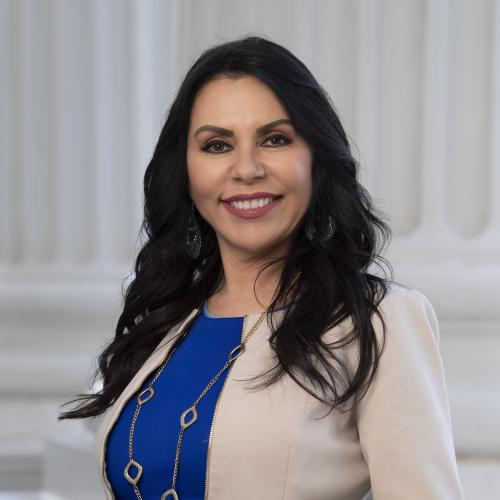
For voters in the 48th Assembly District, Blanca Rubio’s public life follows a local sequence: an elementary-school classroom in Fontana, the Baldwin Park school board and, since 2016, the California State Assembly. Her own history runs from Ciudad Juárez to Texas, deportation, a return to Los Angeles and United States citizenship. In Sacramento, the Baldwin Park Democrat holds committee assignments that range from banking and insurance to aging, audits and governmental organization. Her legislative work has concentrated on domestic violence, children in foster care and immigrant communities.
ROOTS
Blanca Estela Rubio was born in Ciudad Juárez, Mexico, on September 15, 1969. She first came to the United States with her family, settling in Winnie, Texas. She lived in the country as an illegal immigrant, was deported to Juárez and returned illegally with her family to Los Angeles in 1977.
She became a United States citizen in 1994. In office, immigrant communities have been among the constituencies supported by bills she has authored.
Rubio attended Azusa Pacific University, where she received a bachelor’s degree in Business Administration. She also earned a master’s degree in Education with a Multiple Subject Teaching Credential from the university.
Politics also runs through Rubio’s immediate family. Her younger sister, Susan Rubio, is a member of the California State Senate. Their work has at times met in legislation: the two co-sponsored a measure dealing with the time available to pursue certain domestic-violence cases and the training police receive when handling abuse victims.
THE JOB BEFORE THE JOB
Before holding elected office, Rubio was an elementary-school teacher in the Fontana Unified School District.
In 2003, Rubio was elected to the Baldwin Park Unified School District Board of Education. She served two terms as a trustee.
That office placed her on the governing side of the same public system in which she had worked as a teacher. The change was specific: from teaching elementary-school students in Fontana Unified to serving on the board responsible for Baldwin Park Unified.
Education does not stand alone in her later legislative work. Rubio has authored bills creating opportunities for children within the foster care system. The focus is narrower than education policy in general: children whose passage through school can require support from more than one public system.
FROM THE SCHOOL BOARD TO SACRAMENTO
Rubio has served in the California State Assembly since 2016, representing the 48th Assembly District as a Democrat. Her route to the Capitol came through two familiar forms of local public service: teaching and a school district board.
The offices differ in reach and machinery. A school board trustee works within a single district.
Her move to the Assembly did not end the education and child-welfare portion of her work. Bills she has authored include measures intended to create opportunities for children in foster care. But her legislative portfolio also reaches immigrant communities and victims of domestic violence, the latter through both committee leadership and legislation.
The family connection in the Legislature is part of that work rather than merely a biographical detail. Susan Rubio serves in the Senate, while Blanca Rubio serves in the Assembly. Their co-sponsorship of SB 273 joined the two sisters on a measure addressing domestic-violence cases.
THE COMMITTEE MAP
Committee assignments are where much of a legislator’s institutional position becomes visible. Rubio chairs the Assembly’s Governmental Organization Committee and is the first Latina to serve as its chair.
She also sits on the Banking and Finance Standing Committee, the Insurance Standing Committee and the Aging and Long-Term Care Standing Committee. In addition, she serves on the Joint Legislative Audit Committee. Taken together, the assignments give her roles in standing committees and in the Legislature’s joint audit work, alongside her chairmanship.
Rubio also chairs the Select Committee on Domestic Violence. That position sits directly beside one of the principal subjects of her legislation. She has authored and co-authored numerous bills supporting victims of domestic violence.
The distinction matters in reading a legislative career. The Select Committee on Domestic Violence gives Rubio another chairmanship focused on a specific constituency and issue. Her bills supporting abuse victims provide the legislative component of the same work.
The remainder of her committee list is broad: banking, finance, insurance, aging, long-term care and legislative audits. The available record does not tie each assignment to an individual measure. It does show an Assembly member with committee responsibilities extending beyond the issues most closely associated with her authored legislation.
THE LEGISLATIVE RECORD
Rubio’s identified legislative work groups around three sets of people: victims of domestic violence, children in foster care and immigrant communities.
On domestic violence, she has authored and co-authored numerous bills supporting victims. She also co-sponsored SB 273, extending the statute of limitations in certain domestic-violence cases from three years to 10 years. The measure requires additional training for police dealing with abuse victims.
Those provisions act at two different points in the system. The statute-of-limitations change concerns how long victims have to bring certain cases. The training requirement concerns police encounters with abuse victims. Rubio’s position as chair of the Select Committee on Domestic Violence gives the issue an institutional place in her Assembly work as well.
Her work concerning children in foster care is described through bills creating opportunities for those children. It continues a public career that began in elementary education, though now through state legislation rather than a classroom or school district board.
Immigrant communities form the third identified area. Rubio has authored bills supporting them. Her own chronology includes living in the United States as an illegal immigrant, being deported to Juárez, returning to Los Angeles in 1977 and becoming a citizen in 1994. Those events and the legislation belong to the same biography; the facts do not require a claim about motive.
Rubio’s Assembly profile therefore has two parts. One is institutional: chairing Governmental Organization and the Select Committee on Domestic Violence, while serving on four additional committees. The other is constituency-based: domestic-violence victims, foster children and immigrant communities.
THE THROUGH LINE
Domestic violence has the most developed place in her Assembly record: a select-committee chairmanship, numerous authored and co-authored bills, and SB 273’s changes to the statute of limitations and police training.
The interests she has repeatedly served are those of people dealing with public systems at difficult points in their lives. For abuse victims, that means the legal time allowed in certain cases and the conduct of police who encounter them. For children in foster care, it means legislation intended to create opportunities. For immigrant communities, it means authored bills offering support.
Her broader institutional power sits in the committee structure. As chair of Governmental Organization — the first Latina in that position — Rubio holds one of her formal leadership posts. As chair of the Select Committee on Domestic Violence, she holds another in the field most strongly identified with her legislation. Her other assignments put her into the Assembly’s work on banking and finance, insurance, aging and long-term care, and joint legislative audits.
The public career began closer to home: an elementary-school teacher, followed by two terms on the Baldwin Park Unified school board. It now operates through committee chairs, bill authorship and the two-house relationship represented by SB 273 with Susan Rubio. For the voters of the 48th District, that is the shape of Rubio’s record: education before the Legislature, committee authority inside it, and sustained attention to abuse victims, foster children and immigrants.
- State Assembly · Assembly District 48 · 2016–present
For voters in the 48th Assembly District, Blanca Rubio’s public life follows a local sequence: an elementary-school classroom in Fontana, the Baldwin Park school board and, since 2016, the California State Assembly. Her own history runs from Ciudad Juárez to Texas, deportation, a return to Los Angeles and United States citizenship. In Sacramento, the Baldwin Park Democrat holds committee assignments that range from banking and insurance to aging, audits and governmental organization. Her legislative work has concentrated on domestic violence, children in foster care and immigrant communities.
ROOTS
Blanca Estela Rubio was born in Ciudad Juárez, Mexico, on September 15, 1969. She first came to the United States with her family, settling in Winnie, Texas. She lived in the country as an illegal immigrant, was deported to Juárez and returned illegally with her family to Los Angeles in 1977.
She became a United States citizen in 1994. In office, immigrant communities have been among the constituencies supported by bills she has authored.
Rubio attended Azusa Pacific University, where she received a bachelor’s degree in Business Administration. She also earned a master’s degree in Education with a Multiple Subject Teaching Credential from the university.
Politics also runs through Rubio’s immediate family. Her younger sister, Susan Rubio, is a member of the California State Senate. Their work has at times met in legislation: the two co-sponsored a measure dealing with the time available to pursue certain domestic-violence cases and the training police receive when handling abuse victims.
THE JOB BEFORE THE JOB
Before holding elected office, Rubio was an elementary-school teacher in the Fontana Unified School District.
In 2003, Rubio was elected to the Baldwin Park Unified School District Board of Education. She served two terms as a trustee.
That office placed her on the governing side of the same public system in which she had worked as a teacher. The change was specific: from teaching elementary-school students in Fontana Unified to serving on the board responsible for Baldwin Park Unified.
Education does not stand alone in her later legislative work. Rubio has authored bills creating opportunities for children within the foster care system. The focus is narrower than education policy in general: children whose passage through school can require support from more than one public system.
FROM THE SCHOOL BOARD TO SACRAMENTO
Rubio has served in the California State Assembly since 2016, representing the 48th Assembly District as a Democrat. Her route to the Capitol came through two familiar forms of local public service: teaching and a school district board.
The offices differ in reach and machinery. A school board trustee works within a single district.
Her move to the Assembly did not end the education and child-welfare portion of her work. Bills she has authored include measures intended to create opportunities for children in foster care. But her legislative portfolio also reaches immigrant communities and victims of domestic violence, the latter through both committee leadership and legislation.
The family connection in the Legislature is part of that work rather than merely a biographical detail. Susan Rubio serves in the Senate, while Blanca Rubio serves in the Assembly. Their co-sponsorship of SB 273 joined the two sisters on a measure addressing domestic-violence cases.
THE COMMITTEE MAP
Committee assignments are where much of a legislator’s institutional position becomes visible. Rubio chairs the Assembly’s Governmental Organization Committee and is the first Latina to serve as its chair.
She also sits on the Banking and Finance Standing Committee, the Insurance Standing Committee and the Aging and Long-Term Care Standing Committee. In addition, she serves on the Joint Legislative Audit Committee. Taken together, the assignments give her roles in standing committees and in the Legislature’s joint audit work, alongside her chairmanship.
Rubio also chairs the Select Committee on Domestic Violence. That position sits directly beside one of the principal subjects of her legislation. She has authored and co-authored numerous bills supporting victims of domestic violence.
The distinction matters in reading a legislative career. The Select Committee on Domestic Violence gives Rubio another chairmanship focused on a specific constituency and issue. Her bills supporting abuse victims provide the legislative component of the same work.
The remainder of her committee list is broad: banking, finance, insurance, aging, long-term care and legislative audits. The available record does not tie each assignment to an individual measure. It does show an Assembly member with committee responsibilities extending beyond the issues most closely associated with her authored legislation.
THE LEGISLATIVE RECORD
Rubio’s identified legislative work groups around three sets of people: victims of domestic violence, children in foster care and immigrant communities.
On domestic violence, she has authored and co-authored numerous bills supporting victims. She also co-sponsored SB 273, extending the statute of limitations in certain domestic-violence cases from three years to 10 years. The measure requires additional training for police dealing with abuse victims.
Those provisions act at two different points in the system. The statute-of-limitations change concerns how long victims have to bring certain cases. The training requirement concerns police encounters with abuse victims. Rubio’s position as chair of the Select Committee on Domestic Violence gives the issue an institutional place in her Assembly work as well.
Her work concerning children in foster care is described through bills creating opportunities for those children. It continues a public career that began in elementary education, though now through state legislation rather than a classroom or school district board.
Immigrant communities form the third identified area. Rubio has authored bills supporting them. Her own chronology includes living in the United States as an illegal immigrant, being deported to Juárez, returning to Los Angeles in 1977 and becoming a citizen in 1994. Those events and the legislation belong to the same biography; the facts do not require a claim about motive.
Rubio’s Assembly profile therefore has two parts. One is institutional: chairing Governmental Organization and the Select Committee on Domestic Violence, while serving on four additional committees. The other is constituency-based: domestic-violence victims, foster children and immigrant communities.
THE THROUGH LINE
Domestic violence has the most developed place in her Assembly record: a select-committee chairmanship, numerous authored and co-authored bills, and SB 273’s changes to the statute of limitations and police training.
The interests she has repeatedly served are those of people dealing with public systems at difficult points in their lives. For abuse victims, that means the legal time allowed in certain cases and the conduct of police who encounter them. For children in foster care, it means legislation intended to create opportunities. For immigrant communities, it means authored bills offering support.
Her broader institutional power sits in the committee structure. As chair of Governmental Organization — the first Latina in that position — Rubio holds one of her formal leadership posts. As chair of the Select Committee on Domestic Violence, she holds another in the field most strongly identified with her legislation. Her other assignments put her into the Assembly’s work on banking and finance, insurance, aging and long-term care, and joint legislative audits.
The public career began closer to home: an elementary-school teacher, followed by two terms on the Baldwin Park Unified school board. It now operates through committee chairs, bill authorship and the two-house relationship represented by SB 273 with Susan Rubio. For the voters of the 48th District, that is the shape of Rubio’s record: education before the Legislature, committee authority inside it, and sustained attention to abuse victims, foster children and immigrants.
The record
4,463 events, each with its sourceAB 113 GABRIEL Concurrence in Senate Amendments
AB 1128 Muratsuchi Concurrence in Senate Amendments
SB 931 Grove Third Reading Urgency By Krell
AB 28 Schiavo Concurrence in Senate Amendments
AB 187 BUDGET Concurrence in Senate Amendments By GABRIEL
AB 190 BUDGET Concurrence in Senate Amendments By GABRIEL
AB 192 BUDGET Concurrence in Senate Amendments By GABRIEL
AB 353 BOERNER Concurrence in Senate Amendments
AB 605 Muratsuchi Concurrence in Senate Amendments
AB 611 LEE Concurrence in Senate Amendments
AB 664 Alvarez Concurrence in Senate Amendments
AB 760 Ta Concurrence in Senate Amendments
AB 817 GONZÁLEZ, M. Concurrence in Senate Amendments
AB 904 Aguiar-Curry Concurrence in Senate Amendments
AB 1099 Bryan Concurrence in Senate Amendments
AB 1156 WICKS Concurrence in Senate Amendments
AB 1159 Addis Concurrence in Senate Amendments
AB 1199 Patterson Concurrence in Senate Amendments
AB 1294 Haney Concurrence in Senate Amendments
AB 1301 PETRIE-NORRIS Concurrence in Senate Amendments
AB 1307 Ávila Farías Concurrence in Senate Amendments
AB 1331 Elhawary Concurrence in Senate Amendments
AB 1349 BRYAN Concurrence in Senate Amendments Move The Previous Question By AGUIAR-CURRY
AB 1349 BRYAN Concurrence in Senate Amendments
AB 1546 SCHULTZ Concurrence in Senate Amendments
AB 1575 Arambula Concurrence in Senate Amendments
AB 1609 Zbur Concurrence in Senate Amendments
AB 1642 HARABEDIAN Concurrence in Senate Amendments
AB 1646 Bryan Concurrence in Senate Amendments
AB 1680 Calderon Concurrence in Senate Amendments
AB 1707 Davies Concurrence in Senate Amendments
AB 1709 Lowenthal Concurrence in Senate Amendments
AB 1795 GIPSON Concurrence in Senate Amendments
AB 1813 Ward Concurrence in Senate Amendments
AB 1816 Davies Concurrence in Senate Amendments
AB 1841 Ramos Concurrence in Senate Amendments
AB 1871 Fong Concurrence in Senate Amendments
AB 1896 GONZÁLEZ, M. Concurrence in Senate Amendments
AB 1969 BONTA Concurrence in Senate Amendments
AB 1976 Wicks Concurrence in Senate Amendments
AB 1981 Aguiar-Curry Concurrence in Senate Amendments
AB 2012 Hoover Concurrence in Senate Amendments
AB 2020 Gabriel Concurrence in Senate Amendments
AB 2047 Bauer-Kahan Concurrence in Senate Amendments
AB 2059 Wilson Concurrence in Senate Amendments
AB 2061 Chen Concurrence in Senate Amendments
AB 2065 Petrie-Norris Concurrence in Senate Amendments
AB 2071 Hoover Concurrence in Senate Amendments
AB 2086 Ellis Concurrence in Senate Amendments
AB 2103 Irwin Concurrence in Senate Amendments