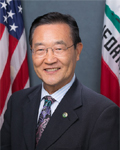
For Irvine voters, Steven Choi’s public life has followed a route from the school board to the City Council, mayor’s office, State Assembly and, in 2024, the State Senate. He has lived in Irvine since 1993, and his two children attended Irvine Unified public schools. His work has also included education, from university teaching to a tutoring and academic enrichment business. The elections did not all go his way: he lost a party committee seat in 2008 and an Assembly primary in 2010. But the longer record runs from his first school-board election in 1998 to his narrow Senate victory over Josh Newman 26 years later.
BACKGROUND AND FORMATION
Steven Seokho Choi was born Jan. 15, 1944, in Naju, Zenranan Province, Korea, then part of the Empire of Japan and now in South Korea. He received a bachelor’s degree from Kyung Hee University in 1966. In August 1968, he moved from South Korea to the United States as a Peace Corps language instructor for the U.S. Department of State.
His education continued here: a master’s degree in library science from Louisiana State University in 1971 and a Ph.D. in library and information science from the University of Pittsburgh in 1976. Choi has taught at the University of Southern California, UC Irvine, Cal State Los Angeles, Henderson State University, Saddleback College and Coastline Community College. He also founded and remains director of Dr. Choi’s Academy, a tutoring and academic enrichment business.
Before settling in Irvine, Choi lived in Mission Viejo from 1981 to 1993. His son, Daniel, became a physician at Kaiser Permanente in Orange County; his daughter, Michelle, is an attorney working in Irvine.
HOME GROUND
Choi entered elected office through the Irvine Unified School District Board of Education in 1998 and won reelection in 2002. In 2004, he moved to the Irvine City Council, becoming the first Asian American elected to a four-year council term. He remained on the council until 2012, when he was elected mayor, and voters returned him to that office in 2014.
The other assignments show the working map of his local career. Choi chaired both the Orange County Public Library Advisory Board and the Irvine Library Advisory Committee. He served on the Orange County Great Park Corporation Board, the Irvine Redevelopment Agency and the Orange County Sanitation District Board. He represented Irvine in Growth Management Areas 4 and 9 and on the Newport Bay Watershed Executive Committee. He also sat on the Concordia University President’s Advisory Council.
During his mayoral tenure, Choi successfully opposed the One-China principle demanded by Shanghai’s Xuhui government. It is a documented instance in his city record of taking a policy position and prevailing.
THE JUMP
Choi’s movement into state politics included two losses before his first Assembly victory. He formerly represented the 71st Assembly District on the Orange County Republican Party Central Committee, but on June 3, 2008, he failed to win reelection to that body. In 2010, he sought a seat in the California State Assembly and narrowly lost the Republican primary.
He tried again in 2016. Choi narrowly defeated Anaheim City Councilman Harry Sidhu in the primary and then won the general election with 60% of the vote, securing a seat in the State Assembly. In 2024, he won election to the State Senate by narrowly defeating Senator Josh Newman.
That progression brought Choi before voters at different levels: a school district, the city, a party committee and state legislative districts. His 2024 Senate victory followed earlier narrow contests, including his 2010 primary loss and his 2016 primary victory.
THE POLICY SIGNATURE
Choi’s record includes a sustained focus on education and the civic infrastructure surrounding it. It includes advanced degrees in library science and library and information science, teaching at six colleges and universities, and his own tutoring and academic enrichment business. In office, it includes the Irvine school board and chairmanship of two library advisory bodies.
His local assignments ranged beyond education. Redevelopment, sanitation, growth management, the Newport Bay watershed and the Great Park placed him on boards and committees addressing development, public works and shared regional concerns. His successful opposition to the One-China principle demanded by Shanghai’s Xuhui government stands apart as a specific policy fight.
Taken together, the record includes work involving students, public education, library institutions and Irvine’s municipal interests. Choi’s state career is the latest office in that sequence. His public career includes election to the Irvine Unified School District Board of Education, university teaching and the founding of a tutoring and academic enrichment business.
- State Assembly · Assembly District 68 · former
- State Senate · Senate District 37 · 2024–present
For Irvine voters, Steven Choi’s public life has followed a route from the school board to the City Council, mayor’s office, State Assembly and, in 2024, the State Senate. He has lived in Irvine since 1993, and his two children attended Irvine Unified public schools. His work has also included education, from university teaching to a tutoring and academic enrichment business. The elections did not all go his way: he lost a party committee seat in 2008 and an Assembly primary in 2010. But the longer record runs from his first school-board election in 1998 to his narrow Senate victory over Josh Newman 26 years later.
BACKGROUND AND FORMATION
Steven Seokho Choi was born Jan. 15, 1944, in Naju, Zenranan Province, Korea, then part of the Empire of Japan and now in South Korea. He received a bachelor’s degree from Kyung Hee University in 1966. In August 1968, he moved from South Korea to the United States as a Peace Corps language instructor for the U.S. Department of State.
His education continued here: a master’s degree in library science from Louisiana State University in 1971 and a Ph.D. in library and information science from the University of Pittsburgh in 1976. Choi has taught at the University of Southern California, UC Irvine, Cal State Los Angeles, Henderson State University, Saddleback College and Coastline Community College. He also founded and remains director of Dr. Choi’s Academy, a tutoring and academic enrichment business.
Before settling in Irvine, Choi lived in Mission Viejo from 1981 to 1993. His son, Daniel, became a physician at Kaiser Permanente in Orange County; his daughter, Michelle, is an attorney working in Irvine.
HOME GROUND
Choi entered elected office through the Irvine Unified School District Board of Education in 1998 and won reelection in 2002. In 2004, he moved to the Irvine City Council, becoming the first Asian American elected to a four-year council term. He remained on the council until 2012, when he was elected mayor, and voters returned him to that office in 2014.
The other assignments show the working map of his local career. Choi chaired both the Orange County Public Library Advisory Board and the Irvine Library Advisory Committee. He served on the Orange County Great Park Corporation Board, the Irvine Redevelopment Agency and the Orange County Sanitation District Board. He represented Irvine in Growth Management Areas 4 and 9 and on the Newport Bay Watershed Executive Committee. He also sat on the Concordia University President’s Advisory Council.
During his mayoral tenure, Choi successfully opposed the One-China principle demanded by Shanghai’s Xuhui government. It is a documented instance in his city record of taking a policy position and prevailing.
THE JUMP
Choi’s movement into state politics included two losses before his first Assembly victory. He formerly represented the 71st Assembly District on the Orange County Republican Party Central Committee, but on June 3, 2008, he failed to win reelection to that body. In 2010, he sought a seat in the California State Assembly and narrowly lost the Republican primary.
He tried again in 2016. Choi narrowly defeated Anaheim City Councilman Harry Sidhu in the primary and then won the general election with 60% of the vote, securing a seat in the State Assembly. In 2024, he won election to the State Senate by narrowly defeating Senator Josh Newman.
That progression brought Choi before voters at different levels: a school district, the city, a party committee and state legislative districts. His 2024 Senate victory followed earlier narrow contests, including his 2010 primary loss and his 2016 primary victory.
THE POLICY SIGNATURE
Choi’s record includes a sustained focus on education and the civic infrastructure surrounding it. It includes advanced degrees in library science and library and information science, teaching at six colleges and universities, and his own tutoring and academic enrichment business. In office, it includes the Irvine school board and chairmanship of two library advisory bodies.
His local assignments ranged beyond education. Redevelopment, sanitation, growth management, the Newport Bay watershed and the Great Park placed him on boards and committees addressing development, public works and shared regional concerns. His successful opposition to the One-China principle demanded by Shanghai’s Xuhui government stands apart as a specific policy fight.
Taken together, the record includes work involving students, public education, library institutions and Irvine’s municipal interests. Choi’s state career is the latest office in that sequence. His public career includes election to the Irvine Unified School District Board of Education, university teaching and the founding of a tutoring and academic enrichment business.
The record
163 events, each with its sourceCalifornia Fairgrounds Appreciation Month.
Asian and Pacific Islander American Heritage Month.
Relative to National Library Week.
American Muslim Appreciation and Awareness Month.
Smog check: motor vehicles: exemption.
Property taxation: exemption: low-value properties.
Electric utility distribution and transmission system facilities: undergrounding and insulation.
Law enforcement: immigration enforcement.
Local government: investments and financial reports.
Vehicles: public safety: Blue Envelope Program.
Personal Income Tax Law: Corporation Tax Law: credits: retail security measures.
Personal income tax: credit: home security surveillance.
Personal Income Tax Law: deferred compensation: exclusions: long-term qualified tuition program.
Motor Vehicle Fuel Tax Law: suspension of tax.
Worker classification: employees and independent contractors: athletic coaches.
Personal income taxes: deduction: California qualified tuition program.
Generators: air pollution regulations: sales and use taxes: exemptions.
Income taxes: exclusions: 2026 Garden Grove chemical leak.
Voter registration: residency confirmation.
Elections: voter identification.
Elections: ballot submission deadline.
Vital records: adoptees’ birth certificates.
California Environmental Quality Act: exemption: Gypsum Canyon Veterans Cemetery.
Income tax: credits: food banks.
Annual tax: partnerships and LLCs.
Unemployment and disability insurance: quality of services: reporting.
California Global Warming Solutions Act of 2006: scoping plan.
Homelessness and mental health: state funding information.
Property taxation: exemption: disabled veteran homeowners.
Governor: pardons and commutations.
Peripartum Cardiomyopathy Awareness Month.
Multifamily Housing Program: Homekey: report.
Relative to the “2-1-1” information and referral service.
Income taxes: gross income exclusions: state of emergency: natural disaster settlements.
Personal income taxes: Fire Safe Home Tax Credits Act.
Recall elections: notice of intention.
Impersonation of a peace officer or firefighter during a state of emergency or local emergency.
Personal income tax: credit: qualified teacher: school supplies.
California Environmental Quality Act: guidelines: study.
California Environmental Quality Act: the Office of Land Use and Climate Innovation: technical advisory.
Safe Drinking Water, Wildfire Prevention, Drought Preparedness, and Clean Air Bond Act of 2024: grants: improvements to public evacuation routes: mobile rigid water storage: electrical generators.