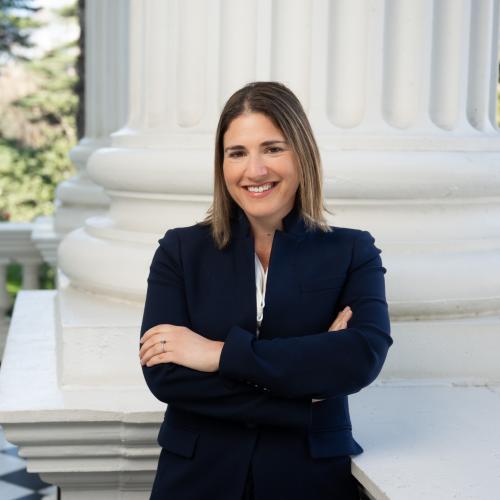
Rebecca Bauer-Kahan lives in Orinda with her husband, Darren Kahan, and their three children, and has represented Assembly District 16 since her first election to the Legislature in 2018. Her route to Sacramento included environmental and intellectual-property law, teaching law and coordinating legal help at San Francisco International Airport for refugees and immigrants affected by the Trump administration’s travel ban. She entered politics following the 2016 presidential election and narrowly unseated Republican incumbent Catharine Baker two years later. In the Assembly, she moved quickly into leadership and committee work, then built a legislative record centered on reproductive rights, privacy, consumer protection and access to health and mental-health services. She has now authored more than 50 measures signed into law.
BACKGROUND AND THE LAW
Born in Portola Valley in 1978, Bauer-Kahan attended Bay Area public schools. She is Jewish; her grandparents arrived in the United States as refugees in 1939 after fleeing Austria to escape the Holocaust. She earned a bachelor’s degree in psychology from the University of Pennsylvania in 2000 and a law degree from Georgetown University in 2004.
Bauer-Kahan practiced in Washington, D.C., before returning to the Bay Area in 2005. Her legal work crossed several parts of the economy and the law. She specialized in environmental law, leading internal corporate investigations intended to improve environmental practices, and handled intellectual-property cases involving technology companies. She also worked as an immigration attorney for the International Refugee Assistance Project. In 2017, she coordinated legal services at San Francisco International Airport for refugees and immigrants affected by the travel ban. Alongside her legal practice, she became a law professor at Santa Clara University in 2010 and joined the Golden Gate University faculty in 2014.
THE ASSEMBLY JOB
Soon after taking office, Bauer-Kahan became assistant speaker pro tempore, a leadership post she left after one term. During that first term, she founded the Select Committee on Reproductive Health, which she continues to chair. She also chairs the Privacy and Consumer Protection Committee and serves on 12 committees in all. Her caucus memberships put her inside several overlapping Assembly coalitions: Democratic, Bay Area, environmental, Jewish, progressive, and technology and innovation.
Her bills range from daily commercial transactions to mental-health response and firearms technology. SB 1053 bans plastic bags at grocery checkout counters. AB 1287 bars the gender-based price differences known as the “Pink Tax,” while AB 1309 shifts the open-enrollment period for affordable health care by 15 days. The Miles Hall Lifeline Act, AB 988, established 988 as a three-digit number for mental-health crisis support. Bauer-Kahan also introduced AB 2047, seeking to prohibit the sale and distribution of consumer 3D printers not equipped with technology to block the manufacture of firearms or components that appear identical to illegal firearm parts.
In May 2024, she spoke for AB 3080, requiring age verification on pornography sites. The bill advanced to the Senate with 65 votes in favor and 15 abstentions. Bauer-Kahan cited reports that about 40% of college women had been choked during sexual encounters and attributed that figure to pornography viewing.
THE POLICY SIGNATURE
Bauer-Kahan is most closely identified with reproductive rights and the legal protections surrounding abortion care. Her signature bill, AB 1666, was signed by Gov. Gavin Newsom on the day Roe v. Wade was overturned. Other measures show the machinery of that work: AB 2099 raises penalties for harassing reproductive-health patients and providers, while AB 352 places guardrails on sharing their medical records across state lines. The committee she founded and still chairs gives that policy area a standing place in the Assembly’s work.
The broader record repeatedly uses legal boundaries to protect people at particular points of exposure: reproductive-health patients and providers facing harassment, consumers facing gender-based pricing, people seeking mental-health help, and health-insurance purchasers facing gaps in enrollment. AB 2664 applies a similar mechanism at houses of worship, restricting protest-related approaches near entrances; it passed the Assembly in June 2026.
For voters assessing where Bauer-Kahan puts her legislative attention, the clearest answer is women’s rights, reproductive patients and providers, medical privacy, and consumer protections. Her committee positions matter alongside the bills. Chairing both reproductive health and privacy gives her a place not only to write legislation, but to organize Assembly work where those two subjects meet.
- State Assembly · Assembly District 16 · 2018–present
Rebecca Bauer-Kahan lives in Orinda with her husband, Darren Kahan, and their three children, and has represented Assembly District 16 since her first election to the Legislature in 2018. Her route to Sacramento included environmental and intellectual-property law, teaching law and coordinating legal help at San Francisco International Airport for refugees and immigrants affected by the Trump administration’s travel ban. She entered politics following the 2016 presidential election and narrowly unseated Republican incumbent Catharine Baker two years later. In the Assembly, she moved quickly into leadership and committee work, then built a legislative record centered on reproductive rights, privacy, consumer protection and access to health and mental-health services. She has now authored more than 50 measures signed into law.
BACKGROUND AND THE LAW
Born in Portola Valley in 1978, Bauer-Kahan attended Bay Area public schools. She is Jewish; her grandparents arrived in the United States as refugees in 1939 after fleeing Austria to escape the Holocaust. She earned a bachelor’s degree in psychology from the University of Pennsylvania in 2000 and a law degree from Georgetown University in 2004.
Bauer-Kahan practiced in Washington, D.C., before returning to the Bay Area in 2005. Her legal work crossed several parts of the economy and the law. She specialized in environmental law, leading internal corporate investigations intended to improve environmental practices, and handled intellectual-property cases involving technology companies. She also worked as an immigration attorney for the International Refugee Assistance Project. In 2017, she coordinated legal services at San Francisco International Airport for refugees and immigrants affected by the travel ban. Alongside her legal practice, she became a law professor at Santa Clara University in 2010 and joined the Golden Gate University faculty in 2014.
THE ASSEMBLY JOB
Soon after taking office, Bauer-Kahan became assistant speaker pro tempore, a leadership post she left after one term. During that first term, she founded the Select Committee on Reproductive Health, which she continues to chair. She also chairs the Privacy and Consumer Protection Committee and serves on 12 committees in all. Her caucus memberships put her inside several overlapping Assembly coalitions: Democratic, Bay Area, environmental, Jewish, progressive, and technology and innovation.
Her bills range from daily commercial transactions to mental-health response and firearms technology. SB 1053 bans plastic bags at grocery checkout counters. AB 1287 bars the gender-based price differences known as the “Pink Tax,” while AB 1309 shifts the open-enrollment period for affordable health care by 15 days. The Miles Hall Lifeline Act, AB 988, established 988 as a three-digit number for mental-health crisis support. Bauer-Kahan also introduced AB 2047, seeking to prohibit the sale and distribution of consumer 3D printers not equipped with technology to block the manufacture of firearms or components that appear identical to illegal firearm parts.
In May 2024, she spoke for AB 3080, requiring age verification on pornography sites. The bill advanced to the Senate with 65 votes in favor and 15 abstentions. Bauer-Kahan cited reports that about 40% of college women had been choked during sexual encounters and attributed that figure to pornography viewing.
THE POLICY SIGNATURE
Bauer-Kahan is most closely identified with reproductive rights and the legal protections surrounding abortion care. Her signature bill, AB 1666, was signed by Gov. Gavin Newsom on the day Roe v. Wade was overturned. Other measures show the machinery of that work: AB 2099 raises penalties for harassing reproductive-health patients and providers, while AB 352 places guardrails on sharing their medical records across state lines. The committee she founded and still chairs gives that policy area a standing place in the Assembly’s work.
The broader record repeatedly uses legal boundaries to protect people at particular points of exposure: reproductive-health patients and providers facing harassment, consumers facing gender-based pricing, people seeking mental-health help, and health-insurance purchasers facing gaps in enrollment. AB 2664 applies a similar mechanism at houses of worship, restricting protest-related approaches near entrances; it passed the Assembly in June 2026.
For voters assessing where Bauer-Kahan puts her legislative attention, the clearest answer is women’s rights, reproductive patients and providers, medical privacy, and consumer protections. Her committee positions matter alongside the bills. Chairing both reproductive health and privacy gives her a place not only to write legislation, but to organize Assembly work where those two subjects meet.
The record
5,236 events, each with its sourceSB 1047 Niello Senate Third Reading By Irwin
SB 1048 Becker Senate Third Reading By Garcia
SB 1067 Weber Pierson Senate Third Reading By Blanca Rubio
SB 1089 Richardson Senate Third Reading By Wicks
SB 1099 Reyes Senate Third Reading By Harabedian
SB 1151 Cervantes Senate Third Reading By Celeste Rodriguez
SB 1218 Arreguín Senate Third Reading By Bonta
SB 1220 Hurtado Senate Third Reading By Schiavo
SB 1227 Durazo Senate Third Reading By Ortega
SB 1250 Cortese Senate Third Reading By HART
SB 1255 Reyes Senate Third Reading By Fong
SB 1261 Laird Third Reading Urgency By Hart
SB 1267 Allen Senate Third Reading By Zbur
SB 1272 Menjivar Senate Third Reading By Stefani
SB 1279 Gonzalez Senate Third Reading By Lowenthal
SB 1283 Ashby Senate Third Reading By Carrillo
SB 1288 Laird Senate Third Reading By Zbur
SB 1299 Arreguín Senate Third Reading By Ransom
SB 1311 Wahab Third Reading Urgency By Berman
SB 1363 Wahab Senate Third Reading By Berman
SB 1368 Wahab Senate Third Reading By Berman
SB 1412 Rubio Senate Third Reading By Patel
SB 1417 Pérez Senate Third Reading By Bennett
SB 1435 Revenue and Taxation Senate Third Reading By GIPSON
SB 1436 Revenue and Taxation Senate Third Reading By GIPSON
SB 1439 Local Government Senate Third Reading By CARRILLO
AB 871 Stefani Concurrence in Senate Amendments
AB 1201 Jackson Concurrence in Senate Amendments
AB 1359 Ahrens Concurrence in Senate Amendments
AB 1579 Valencia Concurrence - Urgency Added
AB 1684 Ward Concurrence in Senate Amendments
AB 1711 Connolly Concurrence in Senate Amendments
AB 1722 Hadwick Concurrence in Senate Amendments
AB 1784 Pellerin Concurrence in Senate Amendments
AB 1786 Harabedian Concurrence in Senate Amendments
AB 1809 Fong Concurrence in Senate Amendments
AB 1837 Mark González Concurrence in Senate Amendments
AB 1860 McKinnor Concurrence in Senate Amendments
AB 1864 Berman Concurrence in Senate Amendments
AB 1894 Blanca Rubio Concurrence in Senate Amendments
AB 1999 Kalra Concurrence in Senate Amendments
AB 2116 Schiavo Concurrence in Senate Amendments
AB 2143 Irwin Concurrence in Senate Amendments
AB 2186 McKinnor Concurrence in Senate Amendments
AB 2233 Ta Concurrence in Senate Amendments
AB 2249 Irwin Concurrence in Senate Amendments
AB 2255 Pellerin Concurrence in Senate Amendments
AB 2380 Papan Concurrence in Senate Amendments
AB 2418 Mark González Concurrence in Senate Amendments
AB 2576 Harabedian Concurrence in Senate Amendments