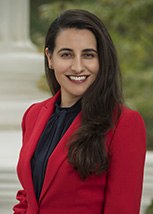
For Senate District 21 voters, Monique Limón’s public life is rooted in institutions close to home: the Santa Barbara Unified School District, the University of California, Santa Barbara, and the Santa Barbara County Commission for Women. Born and raised in Santa Barbara, the daughter of immigrants from Mexico, she moved from local education work to the Legislature without leaving education policy behind. Voters elected her to the Assembly in 2016 and the Senate in 2020. Her legislative record has since widened to wildfire prevention, rebuilding, voter registration and housing. On June 9, 2025, the Senate Democratic caucus voted to promote her as president pro tem, making her the first woman of color to hold the position in California.
HOME GROUND
Limón was born on Oct. 30, 1979. She earned a Bachelor of Arts degree from the University of California, Berkeley, and a Master of Arts from Columbia University.
At UC Santa Barbara, she served as assistant director of the McNair Scholars Program. She also served on the Santa Barbara County Commission for Women. Her longest local elected assignment was six years on the Santa Barbara Unified School District Board of Education.
That work remained visible after she went to Sacramento. In 2017, Jerry Brown signed her bill directing the development of a model Native American studies curriculum for California high schools. It was an early example of the kind of policymaking that has marked her career: state action routed through familiar public institutions, in this case the high school classroom.
THE JUMP
Limón won election to the California State Assembly in 2016, succeeding Das Williams. Four years later, she was elected to the state Senate’s 19th District, succeeding Hannah-Beth Jackson. Those two elections placed her in seats previously held by Williams and Jackson.
Her rise inside the Senate came five years after that election. The Democratic caucus voted unanimously on June 9, 2025, to elevate her to president pro tem. On June 17, 2026, Limón became the first Latina Senate president pro tempore in California history to sign legislation into law as acting governor.
The progression is plain: school board member, Assembly member, senator and then president pro tem. The offices changed, but much of the work remained attached to systems residents routinely encounter—schools, the DMV, housing approvals, wildfire prevention and post-fire rebuilding. Her voter-registration bill would have made registration automatic at California DMVs. Gavin Newsom vetoed it in 2024.
THE POLICY SIGNATURE
Wildfire policy is one of the clearest lines in Limón’s Senate record. In 2023, she introduced a bill to expand prescribed grazing as a wildfire prevention measure. In 2024, she introduced another bill to expand the approval process for prescribed burning. She also authored SB 676, intended to give communities recovering from wildfire-declared emergencies access to rebuilding review procedures available for major projects.
Housing presents a broader and less uniform record. As a Senate leader, Limón supported measures to increase California’s housing supply. She backed SB 827, which increases housing production in high-transit areas, and SB 684, which expands access to home ownership in infill developments.
But in 2025 she sought to stop an eight-story, 270-unit apartment building in her district. She pushed for language in Senate Bill 158 specifically prohibiting the proposed project, even as legislators pursued measures to increase housing supply statewide.
Taken together, the record includes work involving students and public schools, wildfire-threatened and recovering communities, voter registration, and housing or home ownership. It also shows a boundary in her housing work. Limón has supported production in statewide legislation while using the legislative process to oppose a particular large development in her own district.
- State Assembly · Assembly District 37 · former
- State Senate · Senate District 21 · 2024–present
- State Senate · Senate District 19 · 2020–
For Senate District 21 voters, Monique Limón’s public life is rooted in institutions close to home: the Santa Barbara Unified School District, the University of California, Santa Barbara, and the Santa Barbara County Commission for Women. Born and raised in Santa Barbara, the daughter of immigrants from Mexico, she moved from local education work to the Legislature without leaving education policy behind. Voters elected her to the Assembly in 2016 and the Senate in 2020. Her legislative record has since widened to wildfire prevention, rebuilding, voter registration and housing. On June 9, 2025, the Senate Democratic caucus voted to promote her as president pro tem, making her the first woman of color to hold the position in California.
HOME GROUND
Limón was born on Oct. 30, 1979. She earned a Bachelor of Arts degree from the University of California, Berkeley, and a Master of Arts from Columbia University.
At UC Santa Barbara, she served as assistant director of the McNair Scholars Program. She also served on the Santa Barbara County Commission for Women. Her longest local elected assignment was six years on the Santa Barbara Unified School District Board of Education.
That work remained visible after she went to Sacramento. In 2017, Jerry Brown signed her bill directing the development of a model Native American studies curriculum for California high schools. It was an early example of the kind of policymaking that has marked her career: state action routed through familiar public institutions, in this case the high school classroom.
THE JUMP
Limón won election to the California State Assembly in 2016, succeeding Das Williams. Four years later, she was elected to the state Senate’s 19th District, succeeding Hannah-Beth Jackson. Those two elections placed her in seats previously held by Williams and Jackson.
Her rise inside the Senate came five years after that election. The Democratic caucus voted unanimously on June 9, 2025, to elevate her to president pro tem. On June 17, 2026, Limón became the first Latina Senate president pro tempore in California history to sign legislation into law as acting governor.
The progression is plain: school board member, Assembly member, senator and then president pro tem. The offices changed, but much of the work remained attached to systems residents routinely encounter—schools, the DMV, housing approvals, wildfire prevention and post-fire rebuilding. Her voter-registration bill would have made registration automatic at California DMVs. Gavin Newsom vetoed it in 2024.
THE POLICY SIGNATURE
Wildfire policy is one of the clearest lines in Limón’s Senate record. In 2023, she introduced a bill to expand prescribed grazing as a wildfire prevention measure. In 2024, she introduced another bill to expand the approval process for prescribed burning. She also authored SB 676, intended to give communities recovering from wildfire-declared emergencies access to rebuilding review procedures available for major projects.
Housing presents a broader and less uniform record. As a Senate leader, Limón supported measures to increase California’s housing supply. She backed SB 827, which increases housing production in high-transit areas, and SB 684, which expands access to home ownership in infill developments.
But in 2025 she sought to stop an eight-story, 270-unit apartment building in her district. She pushed for language in Senate Bill 158 specifically prohibiting the proposed project, even as legislators pursued measures to increase housing supply statewide.
Taken together, the record includes work involving students and public schools, wildfire-threatened and recovering communities, voter registration, and housing or home ownership. It also shows a boundary in her housing work. Limón has supported production in statewide legislation while using the legislative process to oppose a particular large development in her own district.
The record
4,312 events, each with its sourceUnfinished Business SB577 Laird et al. Concurrence
Unfinished Business SB632 Arreguín et al. Concurrence
Unfinished Business SB677 Wiener et al. Concurrence
Assembly 3rd Reading AB635 Ahrens et al. By Umberg
Assembly 3rd Reading AB282 Pellerin By Wahab Urgency Clause
Assembly 3rd Reading AB540 Connolly By Laird
Assembly 3rd Reading AB605 Muratsuchi By Blakespear
Assembly 3rd Reading AB917 Ávila Farías By Reyes
Assembly 3rd Reading AB1039 Hart et al. By McNerney
Assembly 3rd Reading AB1542 Ward By McNerney
Assembly 3rd Reading AB1602 Blanca Rubio By Arreguín
Assembly 3rd Reading AB1715 Schiavo By Stern
Assembly 3rd Reading AB1815 Wicks et al. By Wiener
Assembly 3rd Reading AB1883 Bryan By McNerney
Assembly 3rd Reading AB1974 Stefani By Blakespear
Assembly 3rd Reading AB1983 Blanca Rubio By Laird
Assembly 3rd Reading AB2074 Haney et al. By Arreguín
Assembly 3rd Reading AB2142 Garcia By Smallwood-Cuevas
Assembly 3rd Reading AB2179 Patel et al. By Blakespear
Assembly 3rd Reading AB2253 Boerner By Reyes
Assembly 3rd Reading AB2344 Haney et al. By Arreguín
Assembly 3rd Reading AB2551 Elhawary By Pérez
Assembly 3rd Reading AB2573 Sharp-Collins By Weber Pierson
Assembly 3rd Reading AB2575 Ortega By Padilla
Assembly 3rd Reading AB2575 Ortega By Padilla Reconsider
Assembly 3rd Reading AB2601 Lee By Arreguín
Assembly 3rd Reading AB2770 Alvarez et al. By Jones
Unfinished Business SB58 Padilla et al. Concurrence
Unfinished Business SB327 McNerney et al. Concurrence
Special Consent SB329 Blakespear et al
Unfinished Business SB331 Menjivar et al. Concurrence
Unfinished Business SB354 Limón Concurrence
Unfinished Business SB420 Padilla et al. Concurrence
Unfinished Business SB526 Pérez Concurrence
Special Consent SB626 Smallwood-Cuevas
Special Consent SB661 Hurtado
Unfinished Business SB675 Padilla Concurrence
Unfinished Business SB690 Caballero et al. Concurrence
Unfinished Business SB750 Cortese et al. Concurrence
Unfinished Business SB804 Archuleta et al. Concurrence
Unfinished Business SB869 Weber Pierson Concurrence
Unfinished Business SB873 Reyes et al. Concurrence
Special Consent SB891 Cervantes et al
Unfinished Business SB938 Menjivar et al. Concurrence
Special Consent SB944 Wiener et al
Unfinished Business SB954 Blakespear et al. Concurrence
Unfinished Business SB969 Reyes et al. Concurrence
Unfinished Business SB989 Blakespear et al. Concurrence
Special Consent SB991 Menjivar et al
Special Consent SB1046 Blakespear et al