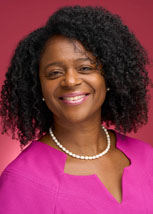
For voters in the 28th Senate District, Lola Smallwood-Cuevas came to Sacramento from the labor institutions of Los Angeles. Before her election to the California State Senate in 2022, she worked at the UCLA Labor Center, founded organizations focused on Black employment and racial equity, and spent more than two decades as a labor organizer, civil rights activist and community advocate. Her most concrete work connected working-class Black residents with jobs, construction training and union resources. She also pressed government contractors to hire locally and spoke against city policies on policing and homelessness. Smallwood-Cuevas succeeded Sydney Kamlager-Dove, who left the Senate after her election to California’s 37th congressional district seat.
THE JOB BEFORE THE JOB
Smallwood-Cuevas was raised by a single mother who worked as a registered nurse and homecare worker. Her own professional record is concentrated in labor organizing and civil rights work. She was at the UCLA Labor Center from 2004 to 2022, serving as its project director for 15 years.
At UCLA, she founded the Los Angeles Black Worker Center, whose mission is to connect working-class Black residents of Los Angeles with employment prospects and unionization resources. She also founded the Center for the Advancement for Racial Equity at Work.
The Black Worker Center did more than make a case for access to construction jobs. By 2015, it had become instrumental in training Black residents to enter the construction industry. It advocated for government contractors to prioritize local hiring. Those efforts led to Black residents making up 20% of the Metro Crenshaw K Line project workforce. In October 2015, President Barack Obama recognized the center’s success. It was national recognition for an operation rooted in the practical local machinery of training, contracting and hiring.
THE PATH TO OFFICE
Smallwood-Cuevas entered the Senate after years of organizing outside elected government, but her public work already involved government decisions and their consequences. In July 2020, she spoke against Los Angeles Mayor Eric Garcetti’s announced expansion of policing in communities of color. She also criticized the Los Angeles City Council’s vote to resume cleaning encampments in special zones.
She called the policing expansion and encampment cleanings “regressive thinking that we need to move beyond.” Her argument joined the two policies to the city’s racial disparities in homelessness: Black residents, she said, were 7% of the population but 40% of those on the street.
That intervention placed her in a familiar position from her labor work: addressing a city policy by identifying which residents would bear its effects. Two years later, voters elected her to represent the 28th Senate District. The opening came when Kamlager-Dove vacated the seat after winning election to Congress. Smallwood-Cuevas moved into state office with a record centered on labor, Black employment and policies affecting marginalized communities.
THE POLICY SIGNATURE
Smallwood-Cuevas is most closely identified with the employment interests of working-class Black residents and with the institutional means of expanding their access to work. The Black Worker Center’s method was specific: connect residents to job prospects and unionization resources, provide construction training, and press government contractors to prioritize local hires. The Metro Crenshaw K Line workforce numbers supplied the measurable result.
Her broader record extends to racial equity at work, through the second center she founded, and to city policies affecting communities of color and people living on the street. In the documented work preceding her Senate service, she used labor organizations, training programs and government contracting advocacy as the working parts of policy.
There is no need to search for an abstract theme. The through line is in the constituencies and the mechanisms she has repeatedly chosen: working-class Black residents, marginalized communities, access to employment, union resources, local hiring and scrutiny of government action. That is the public record Smallwood-Cuevas carried from the UCLA Labor Center into the California Senate.
- State Senate · Senate District 28 · 2022–present
For voters in the 28th Senate District, Lola Smallwood-Cuevas came to Sacramento from the labor institutions of Los Angeles. Before her election to the California State Senate in 2022, she worked at the UCLA Labor Center, founded organizations focused on Black employment and racial equity, and spent more than two decades as a labor organizer, civil rights activist and community advocate. Her most concrete work connected working-class Black residents with jobs, construction training and union resources. She also pressed government contractors to hire locally and spoke against city policies on policing and homelessness. Smallwood-Cuevas succeeded Sydney Kamlager-Dove, who left the Senate after her election to California’s 37th congressional district seat.
THE JOB BEFORE THE JOB
Smallwood-Cuevas was raised by a single mother who worked as a registered nurse and homecare worker. Her own professional record is concentrated in labor organizing and civil rights work. She was at the UCLA Labor Center from 2004 to 2022, serving as its project director for 15 years.
At UCLA, she founded the Los Angeles Black Worker Center, whose mission is to connect working-class Black residents of Los Angeles with employment prospects and unionization resources. She also founded the Center for the Advancement for Racial Equity at Work.
The Black Worker Center did more than make a case for access to construction jobs. By 2015, it had become instrumental in training Black residents to enter the construction industry. It advocated for government contractors to prioritize local hiring. Those efforts led to Black residents making up 20% of the Metro Crenshaw K Line project workforce. In October 2015, President Barack Obama recognized the center’s success. It was national recognition for an operation rooted in the practical local machinery of training, contracting and hiring.
THE PATH TO OFFICE
Smallwood-Cuevas entered the Senate after years of organizing outside elected government, but her public work already involved government decisions and their consequences. In July 2020, she spoke against Los Angeles Mayor Eric Garcetti’s announced expansion of policing in communities of color. She also criticized the Los Angeles City Council’s vote to resume cleaning encampments in special zones.
She called the policing expansion and encampment cleanings “regressive thinking that we need to move beyond.” Her argument joined the two policies to the city’s racial disparities in homelessness: Black residents, she said, were 7% of the population but 40% of those on the street.
That intervention placed her in a familiar position from her labor work: addressing a city policy by identifying which residents would bear its effects. Two years later, voters elected her to represent the 28th Senate District. The opening came when Kamlager-Dove vacated the seat after winning election to Congress. Smallwood-Cuevas moved into state office with a record centered on labor, Black employment and policies affecting marginalized communities.
THE POLICY SIGNATURE
Smallwood-Cuevas is most closely identified with the employment interests of working-class Black residents and with the institutional means of expanding their access to work. The Black Worker Center’s method was specific: connect residents to job prospects and unionization resources, provide construction training, and press government contractors to prioritize local hires. The Metro Crenshaw K Line workforce numbers supplied the measurable result.
Her broader record extends to racial equity at work, through the second center she founded, and to city policies affecting communities of color and people living on the street. In the documented work preceding her Senate service, she used labor organizations, training programs and government contracting advocacy as the working parts of policy.
There is no need to search for an abstract theme. The through line is in the constituencies and the mechanisms she has repeatedly chosen: working-class Black residents, marginalized communities, access to employment, union resources, local hiring and scrutiny of government action. That is the public record Smallwood-Cuevas carried from the UCLA Labor Center into the California Senate.
The record
3,877 events, each with its sourceUnfinished Business SB294 Reyes et al. Concurrence
Unfinished Business SB105 Wiener Concurrence
Special Consent SR66 McGuire
That the Assembly amendments be concurred in
Unfinished Business SB326 Becker et al. Concurrence
Unfinished Business SB157 B. & F.R. (Wiener) Concurrence
Unfinished Business SB787 McNerney et al. Concurrence
Unfinished Business SB153 B. & F.R. (Wiener) Concurrence
Unfinished Business SB151 B. & F.R. (Wiener) Concurrence
Unfinished Business SB415 Reyes et al. Concurrence
Unfinished Business SB767 Richardson et al. Concurrence
Unfinished Business SB776 Ashby Concurrence
Unfinished Business SB809 Durazo et al. Concurrence
Unfinished Business SB148 B. & F.R. (Wiener) Concurrence
Unfinished Business SB763 Hurtado Concurrence
Unfinished Business SB160 B. & F.R. (Wiener) Concurrence
Unfinished Business SB274 Cervantes et al. Concurrence
Assembly 3rd Reading AB1388 Bryan By Arreguín
Unfinished Business SB761 Ashby et al. Concurrence
Unfinished Business SB7 McNerney et al. Concurrence
Unfinished Business SB161 B. & F.R. (Wiener) Concurrence
Unfinished Business SB155 B. & F.R. (Wiener) Concurrence
Unfinished Business SB760 Allen et al. Concurrence
Assembly 3rd Reading AB149 BUDGET (Gabriel) By Wiener
Assembly 3rd Reading AB144 BUDGET (Gabriel) By Wiener
Unfinished Business SB11 Ashby Concurrence
Assembly 3rd Reading AB1376 Bonta et al. By Arreguín
Assembly 3rd Reading AB8 Aguiar-Curry By Ashby
Unfinished Business SB271 Reyes Concurrence
Unfinished Business SB541 Becker et al. Concurrence
Unfinished Business SB756 Smallwood-Cuevas Concurrence
Unfinished Business SB822 Becker et al. Concurrence
Unfinished Business SB378 Wiener Concurrence
Unfinished Business SB162 B. & F.R. (Wiener) Concurrence
Assembly 3rd Reading AB572 Kalra et al. By Cortese
Unfinished Business SB547 Pérez et al. Concurrence
Unfinished Business SB753 Cortese Concurrence
Assembly 2nd Reading AB596 Ortega By Cervantes
Unfinished Business SB553 Cortese Concurrence
Unfinished Business SB744 Cabaldon Concurrence
Assembly 3rd Reading AB357 Alvarez By Wiener
Special Consent AB1524 JUD. (Kalra)
Unfinished Business SB292 Cervantes Concurrence
Unfinished Business SB792 Arreguín et al. Concurrence
Unfinished Business SB793 Archuleta Concurrence
Special Consent SR61 Pérez et al
Special Consent SR59 Niello
Special Consent SR55 Hurtado
Unfinished Business SB805 Pérez et al. Urgency Clause Concurrence
Assembly 3rd Reading AB56 Bauer-Kahan et al. By Weber Pierson