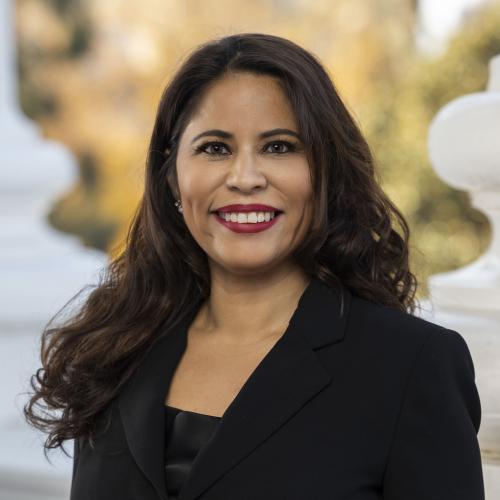
Liz Ortega’s route to Sacramento ran through the Alameda Labor Council and the unions where she worked before voters sent her to the Assembly. She began as a receptionist for SEIU in 2001, then moved through labor education, nursing-home work and political leadership. At AFSCME Local 3299, she lobbied the Legislature for the successful passage of legislation protecting essential service jobs at University of California campuses. She returned to the Alameda Labor Council in 2017 as its executive secretary-treasurer, the first Latina to hold that position. In 2022, Ortega defeated Dublin City Councilmember Shawn Kumagai for the 20th Assembly District seat. She took office on December 5 of that year, carrying a labor résumé into a district made up of Alameda County communities.
ROOTS
Elizabeth Ortega-Toro was born August 26, 1977, in Guadalajara, Mexico. She came to the United States at age three with her mother and brother; her father had immigrated earlier. They crossed the border in San Diego and settled in the Fruitvale neighborhood of Oakland, where Ortega was raised and attended public school.
She later attended the Oakland campus of the University of Phoenix. In 2009, she earned a bachelor of science in criminal justice administration. Her career has included positions at SEIU, AFSCME Local 3299 and the Alameda Labor Council.
Ortega is married to Jason Toro, and they have four children. Her biography includes immigration, Oakland public schools, higher education completed during her labor career and family life. Those particulars sit alongside the institutions where she worked before entering elected office: SEIU, AFSCME Local 3299 and the Alameda Labor Council.
THE JOB BEFORE THE JOB
Ortega’s labor career began at the front desk. After working as an SEIU receptionist, she became an education trainer and later assistant director of Education and Nursing Homes. The jobs moved from administration to training and management before she took on an explicitly political role.
From 2011 to 2013, Ortega served as political director for the Alameda Labor Council. In 2013, she joined AFSCME Local 3299 as statewide political director. Based in Sacramento, she lobbied the California State Legislature for the successful passage of legislation to protect essential service jobs at all University of California campuses.
In 2017, she returned to the Alameda Labor Council as executive secretary-treasurer. She was the first Latina to lead the council in that position. The post followed years spent working at SEIU, serving as political director of the Alameda Labor Council and leading statewide political work for AFSCME Local 3299. By the time she ran for the Assembly, Ortega had lobbied state legislators in Sacramento and held political and leadership positions in Alameda County labor institutions.
THE PATH TO OFFICE
Ortega was first elected to the Assembly in 2022. She defeated Shawn Kumagai, a Dublin City Councilmember, and was sworn into the California State Assembly on December 5, 2022. She represents the 20th district and is a member of the California Legislative Progressive Caucus.
The election moved Ortega from labor leadership into the chamber where she previously had worked as a lobbyist. Her career before the election included work at SEIU, political leadership at the Alameda Labor Council, statewide political work for AFSCME Local 3299 and leadership of the county labor council. Before taking office, she had already worked in Sacramento to lobby for legislation protecting essential service jobs throughout the University of California system.
THE THROUGH LINE
Ortega’s documented career combines labor leadership with state politics. While serving as statewide political director for AFSCME Local 3299, she was based in Sacramento and lobbied the Legislature for the successful passage of legislation protecting essential service jobs at UC campuses.
Her labor work included education and nursing-home responsibilities at SEIU, political leadership at AFSCME Local 3299 and two periods at the Alameda Labor Council. She served as the council’s political director from 2011 to 2013 and returned in 2017 as its executive secretary-treasurer.
Her election to the Assembly in 2022 changed her place in the legislative process, from lobbying lawmakers to serving as one. She entered office with experience in labor education, union political work, county labor leadership and lobbying for legislation protecting essential service jobs. That labor career preceded her election to represent the 20th district.
- State Assembly · Assembly District 20 · 2022–present
Liz Ortega’s route to Sacramento ran through the Alameda Labor Council and the unions where she worked before voters sent her to the Assembly. She began as a receptionist for SEIU in 2001, then moved through labor education, nursing-home work and political leadership. At AFSCME Local 3299, she lobbied the Legislature for the successful passage of legislation protecting essential service jobs at University of California campuses. She returned to the Alameda Labor Council in 2017 as its executive secretary-treasurer, the first Latina to hold that position. In 2022, Ortega defeated Dublin City Councilmember Shawn Kumagai for the 20th Assembly District seat. She took office on December 5 of that year, carrying a labor résumé into a district made up of Alameda County communities.
ROOTS
Elizabeth Ortega-Toro was born August 26, 1977, in Guadalajara, Mexico. She came to the United States at age three with her mother and brother; her father had immigrated earlier. They crossed the border in San Diego and settled in the Fruitvale neighborhood of Oakland, where Ortega was raised and attended public school.
She later attended the Oakland campus of the University of Phoenix. In 2009, she earned a bachelor of science in criminal justice administration. Her career has included positions at SEIU, AFSCME Local 3299 and the Alameda Labor Council.
Ortega is married to Jason Toro, and they have four children. Her biography includes immigration, Oakland public schools, higher education completed during her labor career and family life. Those particulars sit alongside the institutions where she worked before entering elected office: SEIU, AFSCME Local 3299 and the Alameda Labor Council.
THE JOB BEFORE THE JOB
Ortega’s labor career began at the front desk. After working as an SEIU receptionist, she became an education trainer and later assistant director of Education and Nursing Homes. The jobs moved from administration to training and management before she took on an explicitly political role.
From 2011 to 2013, Ortega served as political director for the Alameda Labor Council. In 2013, she joined AFSCME Local 3299 as statewide political director. Based in Sacramento, she lobbied the California State Legislature for the successful passage of legislation to protect essential service jobs at all University of California campuses.
In 2017, she returned to the Alameda Labor Council as executive secretary-treasurer. She was the first Latina to lead the council in that position. The post followed years spent working at SEIU, serving as political director of the Alameda Labor Council and leading statewide political work for AFSCME Local 3299. By the time she ran for the Assembly, Ortega had lobbied state legislators in Sacramento and held political and leadership positions in Alameda County labor institutions.
THE PATH TO OFFICE
Ortega was first elected to the Assembly in 2022. She defeated Shawn Kumagai, a Dublin City Councilmember, and was sworn into the California State Assembly on December 5, 2022. She represents the 20th district and is a member of the California Legislative Progressive Caucus.
The election moved Ortega from labor leadership into the chamber where she previously had worked as a lobbyist. Her career before the election included work at SEIU, political leadership at the Alameda Labor Council, statewide political work for AFSCME Local 3299 and leadership of the county labor council. Before taking office, she had already worked in Sacramento to lobby for legislation protecting essential service jobs throughout the University of California system.
THE THROUGH LINE
Ortega’s documented career combines labor leadership with state politics. While serving as statewide political director for AFSCME Local 3299, she was based in Sacramento and lobbied the Legislature for the successful passage of legislation protecting essential service jobs at UC campuses.
Her labor work included education and nursing-home responsibilities at SEIU, political leadership at AFSCME Local 3299 and two periods at the Alameda Labor Council. She served as the council’s political director from 2011 to 2013 and returned in 2017 as its executive secretary-treasurer.
Her election to the Assembly in 2022 changed her place in the legislative process, from lobbying lawmakers to serving as one. She entered office with experience in labor education, union political work, county labor leadership and lobbying for legislation protecting essential service jobs. That labor career preceded her election to represent the 20th district.
The record
4,848 events, each with its sourceAB 2713 Wicks Concurrence in Senate Amendments
AB 2782 Judiciary Concurrence in Senate Amendments By KALRA
SB 259 Wahab Third Reading Urgency By Pellerin
SB 690 Caballero Senate Third Reading By BAUER-KAHAN
SB 811 Caballero Senate Third Reading By Blanca Rubio
SB 1078 Laird Senate Third Reading By Pellerin
SB 1090 Pérez Third Reading Urgency By Harabedian
SB 1111 Ashby Senate Third Reading By Bauer-Kahan
SB 1168 McNerney Senate Third Reading By Rogers
AB 280 Aguiar-Curry Concurrence in Senate Amendments
AB 306 Schultz Concurrence in Senate Amendments
AB 395 Gabriel Concurrence in Senate Amendments
AB 464 Aguiar-Curry Concurrence in Senate Amendments
AB 643 Wilson Concurrence in Senate Amendments
AB 672 Caloza Concurrence in Senate Amendments
AB 685 Solache Concurrence in Senate Amendments
AB 706 Aguiar-Curry Concurrence in Senate Amendments
AB 750 Quirk-Silva Concurrence in Senate Amendments
AB 883 Lowenthal Concurrence in Senate Amendments By RODRIGUEZ, C
AB 939 Schultz Concurrence in Senate Amendments
AB 956 Quirk-Silva Concurrence in Senate Amendments
AB 1049 Celeste Rodriguez Concurrence in Senate Amendments
AB 1165 Gipson Concurrence in Senate Amendments
AB 1381 Muratsuchi Concurrence in Senate Amendments
AB 1439 Garcia Concurrence in Senate Amendments
AB 1448 Hart Concurrence in Senate Amendments
AB 1457 Bryan Concurrence in Senate Amendments
AB 1519 Gipson Concurrence in Senate Amendments
AB 1577 Bauer-Kahan Concurrence in Senate Amendments
AB 1615 Nguyen Concurrence in Senate Amendments
AB 1626 Gabriel Concurrence in Senate Amendments
AB 1641 Jackson Concurrence in Senate Amendments
AB 1650 Caloza Concurrence in Senate Amendments
AB 1679 Mark González Concurrence in Senate Amendments
AB 1689 Quirk-Silva Concurrence in Senate Amendments
AB 1731 Wilson Concurrence in Senate Amendments
AB 1753 Stefani Concurrence in Senate Amendments
AB 1755 Sharp-Collins Concurrence in Senate Amendments
AB 1766 Krell Concurrence in Senate Amendments
AB 1770 Garcia Concurrence in Senate Amendments
AB 1836 Gabriel Concurrence in Senate Amendments
AB 1838 Berman Concurrence in Senate Amendments
AB 1856 Wicks Concurrence in Senate Amendments
AB 1857 Aguiar-Curry Concurrence in Senate Amendments
AB 1886 Elhawary Concurrence in Senate Amendments
AB 1889 Ramos Concurrence in Senate Amendments
AB 1891 Connolly Concurrence in Senate Amendments
AB 1901 Berman Concurrence in Senate Amendments
AB 1917 Schultz Concurrence in Senate Amendments