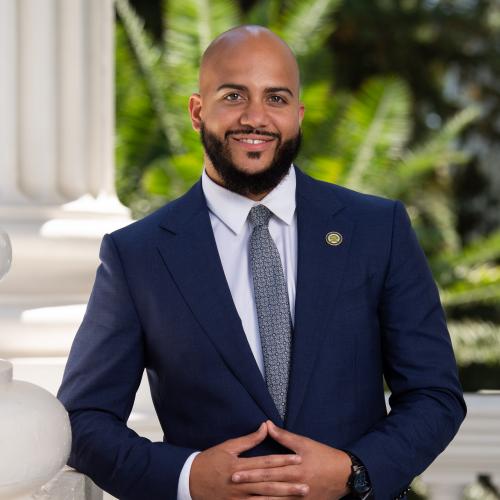
Before his Assembly election, Isaac Bryan worked at UCLA and in the mayor’s Office of Reentry, issued reports on interactions between students and the Los Angeles School Police Department, and helped lead a county funding initiative. He co-chaired Measure J, the county initiative approved by more than 2.1 million voters to divert money toward community investment and alternatives to incarceration. At UCLA, he led a project aimed at connecting Black scholarship with public-policy decisions and examined interactions between school police and students. In 2021, he moved from that work into the Assembly by winning a six-candidate special election. His legislative record has included criminal justice, poverty, foster youth and other public-policy issues.
BACKGROUND AND FORMATION
Bryan was born Jan. 16, 1992, in Dallas to a teenage mother living in poverty who gave him up at birth. He was adopted as an infant. His family fostered hundreds of children over two decades and adopted Bryan and eight others from the child welfare system.
He has lived in California since sixth grade and attended seven public schools and two California community colleges before earning a bachelor’s degree in political science and sociology from the University of Arizona. At the Rombach Institute on Crime, Delinquency and Corrections, he worked as a research fellow on juvenile justice and criminal justice reform. He also worked with a team of federal monitors to enforce a U.S. Department of Justice consent decree with the Maricopa County Sheriff’s Office.
Bryan later earned a Master of Public Policy from the UCLA Luskin School of Public Affairs. Named a David Bohnett Foundation fellow in 2017, he served in Mayor Eric Garcetti’s Office of Reentry and co-authored the city’s first report on the holistic needs of Angelenos involved with the justice system.
THE JOB BEFORE THE JOB
At UCLA, Bryan became the founding director of the Black Policy Project, created to build connections between Black scholarship at the university and public-policy decision-making. He also served as director of Public Policy for the Ralph J. Bunche Center for African American Studies and authored numerous studies and reports. He regularly provided media commentary on racial inequality in the United States.
With the Million Dollar Hoods Project, Bryan issued reports examining interactions between students and the Los Angeles School Police Department. During the summer of 2020, after the murder of George Floyd, he led peaceful protests in Los Angeles. He also articulated “defunding police” as a call to question the size of tax contributions to policing and criminalization at the expense of social services.
Bryan co-chaired Los Angeles County’s Measure J. Approved by more than 2.1 million voters, the measure diverts at least 10% of county general funds to address the disproportionate impact of racial injustice through community investment and alternatives to incarceration. He continued to write and provide commentary on policing and justice reform, including the need to end the criminalization of poverty.
THE ASSEMBLY RECORD
Bryan announced his Assembly candidacy in 2021 to succeed fellow Democrat Sydney Kamlager. His campaign drew endorsements from many people across Los Angeles. Facing five other candidates, he secured more than 50% in the primary, won the special election for the 54th District outright and was sworn into office.
In the Legislature, Bryan established the UCLA Center on Reproductive Health Law and Policy and a registry for people living with ALS. He improved student health-insurance coverage, expanded restorative-justice practices and shut down California’s largest urban oil field.
Bryan also ended prison gerrymandering and returned millions in stolen foster-youth benefits. He started a select committee on Poverty and Economic Inclusion.
Bryan is a member of the California Legislative Progressive Caucus. In 2024, he was elected vice-chair of the California Legislative Black Caucus.
THE THROUGH LINE
Bryan’s documented work repeatedly includes criminal justice and poverty. Measure J diverted at least 10% of county general funds toward community investment and alternatives to incarceration. In the Legislature, he ended prison gerrymandering and expanded restorative-justice practices.
Groups identified in his work include people with justice-system involvement, students encountering school police, foster youth and people living in poverty. His legislative work also included establishing a registry for people living with ALS, improving student health-insurance coverage, shutting down an urban oil field and establishing a reproductive-health law and policy center.
The overlap between poverty and government authority appears throughout that record. Bryan co-authored a report on the needs of Angelenos with justice-system involvement, issued reports on interactions between students and school police, provided commentary on racial inequality, advocated ending the criminalization of poverty, co-chaired a county funding measure, and pursued legislative actions involving prison gerrymandering, foster-youth benefits, restorative justice and a committee on poverty and economic inclusion.
- State Assembly · Assembly District 55 · 2022–present
- State Assembly · Assembly District 54 · 2021–
Before his Assembly election, Isaac Bryan worked at UCLA and in the mayor’s Office of Reentry, issued reports on interactions between students and the Los Angeles School Police Department, and helped lead a county funding initiative. He co-chaired Measure J, the county initiative approved by more than 2.1 million voters to divert money toward community investment and alternatives to incarceration. At UCLA, he led a project aimed at connecting Black scholarship with public-policy decisions and examined interactions between school police and students. In 2021, he moved from that work into the Assembly by winning a six-candidate special election. His legislative record has included criminal justice, poverty, foster youth and other public-policy issues.
BACKGROUND AND FORMATION
Bryan was born Jan. 16, 1992, in Dallas to a teenage mother living in poverty who gave him up at birth. He was adopted as an infant. His family fostered hundreds of children over two decades and adopted Bryan and eight others from the child welfare system.
He has lived in California since sixth grade and attended seven public schools and two California community colleges before earning a bachelor’s degree in political science and sociology from the University of Arizona. At the Rombach Institute on Crime, Delinquency and Corrections, he worked as a research fellow on juvenile justice and criminal justice reform. He also worked with a team of federal monitors to enforce a U.S. Department of Justice consent decree with the Maricopa County Sheriff’s Office.
Bryan later earned a Master of Public Policy from the UCLA Luskin School of Public Affairs. Named a David Bohnett Foundation fellow in 2017, he served in Mayor Eric Garcetti’s Office of Reentry and co-authored the city’s first report on the holistic needs of Angelenos involved with the justice system.
THE JOB BEFORE THE JOB
At UCLA, Bryan became the founding director of the Black Policy Project, created to build connections between Black scholarship at the university and public-policy decision-making. He also served as director of Public Policy for the Ralph J. Bunche Center for African American Studies and authored numerous studies and reports. He regularly provided media commentary on racial inequality in the United States.
With the Million Dollar Hoods Project, Bryan issued reports examining interactions between students and the Los Angeles School Police Department. During the summer of 2020, after the murder of George Floyd, he led peaceful protests in Los Angeles. He also articulated “defunding police” as a call to question the size of tax contributions to policing and criminalization at the expense of social services.
Bryan co-chaired Los Angeles County’s Measure J. Approved by more than 2.1 million voters, the measure diverts at least 10% of county general funds to address the disproportionate impact of racial injustice through community investment and alternatives to incarceration. He continued to write and provide commentary on policing and justice reform, including the need to end the criminalization of poverty.
THE ASSEMBLY RECORD
Bryan announced his Assembly candidacy in 2021 to succeed fellow Democrat Sydney Kamlager. His campaign drew endorsements from many people across Los Angeles. Facing five other candidates, he secured more than 50% in the primary, won the special election for the 54th District outright and was sworn into office.
In the Legislature, Bryan established the UCLA Center on Reproductive Health Law and Policy and a registry for people living with ALS. He improved student health-insurance coverage, expanded restorative-justice practices and shut down California’s largest urban oil field.
Bryan also ended prison gerrymandering and returned millions in stolen foster-youth benefits. He started a select committee on Poverty and Economic Inclusion.
Bryan is a member of the California Legislative Progressive Caucus. In 2024, he was elected vice-chair of the California Legislative Black Caucus.
THE THROUGH LINE
Bryan’s documented work repeatedly includes criminal justice and poverty. Measure J diverted at least 10% of county general funds toward community investment and alternatives to incarceration. In the Legislature, he ended prison gerrymandering and expanded restorative-justice practices.
Groups identified in his work include people with justice-system involvement, students encountering school police, foster youth and people living in poverty. His legislative work also included establishing a registry for people living with ALS, improving student health-insurance coverage, shutting down an urban oil field and establishing a reproductive-health law and policy center.
The overlap between poverty and government authority appears throughout that record. Bryan co-authored a report on the needs of Angelenos with justice-system involvement, issued reports on interactions between students and school police, provided commentary on racial inequality, advocated ending the criminalization of poverty, co-chaired a county funding measure, and pursued legislative actions involving prison gerrymandering, foster-youth benefits, restorative justice and a committee on poverty and economic inclusion.
The record
5,016 events, each with its sourceAJR 9 Wallis Concurrence in Senate Amendments
SB 296 Archuleta Senate Third Reading By Schiavo
SB 401 Hurtado Senate Third Reading By Irwin
SB 479 Arreguín Senate Third Reading By Wicks
SB 599 Caballero Senate Third Reading By Ward
SB 692 Arreguín Senate Third Reading By Mark González
SB 872 McNerney Senate Third Reading By Harabedian
SB 925 McNerney Senate Third Reading By Calderon
SB 932 Hurtado Senate Third Reading By Papan
SB 934 Wiener Senate Third Reading By Ward
SB 945 Weber Pierson Senate Third Reading By Alanis
SB 977 Weber Pierson Senate Third Reading By Schiavo
SB 990 Grove Senate Third Reading By Ellis
SB 1030 Smallwood-Cuevas Senate Third Reading By Sharp-Collins
SB 1056 Grayson Senate Third Reading By Schultz
SB 1069 Grayson Senate Third Reading By Wilson
SB 1135 Blakespear Senate Third Reading By Rogers
SB 1149 Durazo Senate Third Reading By Wicks
SB 1154 Reyes Senate Third Reading By Schultz
SB 1192 Rubio Senate Third Reading By Stefani
SB 1194 Caballero Senate Third Reading By Bonta
SB 1263 McGuire Senate Third Reading By Rogers
SB 1264 Valladares Senate Third Reading By Dixon
SB 1354 Archuleta Senate Third Reading By Schiavo
SB 1371 Durazo Senate Third Reading By Harabedian
SB 1400 Arreguín Senate Third Reading By Ortega
SCR 129 Cortese Senate Third Reading By Calderon
SCR 142 Becker Consent Calendar Second Day Regular Session
SCR 182 Seyarto Consent Calendar Second Day Regular Session
SCR 186 Grayson Consent Calendar Second Day Regular Session
SCR 188 Pérez Consent Calendar Second Day Regular Session
SCR 191 Seyarto Consent Calendar Second Day Regular Session
SCR 192 Stern Consent Calendar Second Day Regular Session
SCR 195 Reyes Consent Calendar Second Day Regular Session
SCR 196 Limón Consent Calendar Second Day Regular Session
SJR 16 Caballero Senate Third Reading By Wilson
AB 442 Hadwick Concurrence in Senate Amendments
AB 1145 Jeff Gonzalez Concurrence in Senate Amendments
AB 2042 Kalra Concurrence in Senate Amendments
ACR 162 Hadwick Concurrence in Senate Amendments
ACR 228 Wilson Consent Calendar Second Day
AJR 17 Celeste Rodriguez Concurrence in Senate Amendments
SB 505 Richardson Senate Third Reading By Krell
SB 799 Allen Senate Third Reading By Muratsuchi
SB 881 McNerney Third Reading Urgency By Soria
SB 941 Padilla Senate Third Reading By Carrillo
SB 971 Choi Senate Third Reading By Garcia
SB 994 Cabaldon Senate Third Reading By Carrillo
SB 1115 Grove Senate Third Reading By Macedo
SB 1169 Grayson Senate Third Reading By Carrillo