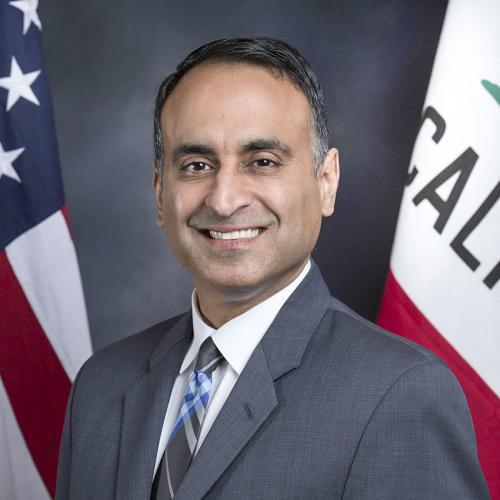
Oak Grove High School, the Santa Clara County public defender’s office, the San Jose City Council and the State Assembly mark Ash Kalra’s route through public life. Born in Toronto to Punjabi parents from India, he came to the United States with his family in 1978 and settled in San Jose, where he has lived ever since. He taught law and spent 11 years representing people charged with felonies and misdemeanors, much of that time in drug treatment court. He won a South San Jose council seat in 2008 and moved to the Assembly in 2016. Today, he holds three positions that locate him within the Legislature: chair of the progressive caucus, chair of the labor committee and chair of a select committee devoted to the future of work and workers.
ROOTS
Kalra attended San Jose public schools and graduated from Oak Grove High School. He earned a bachelor’s degree in communications from the University of California, Santa Barbara, in 1993, followed by a law degree from Georgetown University in 1996. While studying law, he taught at inner-city schools in Washington, D.C.
His life since his family’s arrival in 1978 has remained centered in San Jose. He later taught law at San Jose State University and Lincoln Law School, worked for Santa Clara County and represented South San Jose on the City Council. Kalra practices Hinduism and is vegan. His 2016 election made him the first Hindu and Indian American to serve in the California State Legislature.
THE JOB BEFORE THE JOB
Kalra’s work as a deputy public defender lasted 11 years. He handled felony and misdemeanor trials, but spent most of his time in drug treatment court, helping clients enter rehabilitation programs. That work placed him inside a part of county government where criminal cases, treatment programs and individual lives meet.
He also worked as a law professor at San Jose State University and Lincoln Law School. His work combined courtroom representation as a Santa Clara County deputy public defender with legal instruction at San Jose State University and Lincoln Law School.
Kalra entered elected office in 2008, winning the District 2 seat on the San Jose City Council. The district encompassed South San Jose, and he served two terms. In 2011, while on the council, he was arrested for driving under the influence of alcohol and pleaded no contest. He was sentenced to community service and counseling.
THE PATH TO THE ASSEMBLY
In 2016, Kalra ran for the State Assembly seat held by term-limited Democrat Nora Campos. He defeated fellow Democrat and San Jose councilmember Madison Nguyen and was first elected to the Assembly in 2016.
His institutional position now runs through the Legislature’s progressive and labor ranks. He chairs the California Legislative Progressive Caucus, the Assembly Labor and Employment Committee and the Assembly Select Committee on the Future of Work and Workers. Those posts give him formal roles in organizing progressive legislators and overseeing committees concerned with employment and changes in work.
Kalra supported Bernie Sanders’s 2020 presidential campaign. When Xavier Becerra left the California attorney general’s office, Kalra was mentioned as a possible replacement; Rob Bonta received the appointment instead. The episode did not change Kalra’s office, but it placed his name in consideration for a statewide law-enforcement position.
THE POLICY SIGNATURE
Kalra authored the California Racial Justice Act of 2020. That work followed an earlier public record spent representing criminal defendants, including clients seeking entry into rehabilitation programs.
His committee assignments put workers and employment within his formal reach. He chairs both the standing Assembly committee on labor and employment and the select committee on the future of work and workers, while also leading the progressive caucus.
A 2023 bill showed another side of his approach to government enforcement. Kalra authored legislation that would prohibit towing or immobilizing vehicles because of unpaid parking tickets. The proposal would remove two consequences faced by vehicle owners with outstanding tickets. It also drew a direct objection: a San Jose Department of Transportation spokesperson said the bill would make parking enforcement in the city more difficult. Taken together, Kalra’s documented work centers on criminal defendants, people directed toward rehabilitation, workers and motorists facing penalties over unpaid tickets.
- State Assembly · Assembly District 27 · former
- State Assembly · Assembly District 25 · 2022–present
Oak Grove High School, the Santa Clara County public defender’s office, the San Jose City Council and the State Assembly mark Ash Kalra’s route through public life. Born in Toronto to Punjabi parents from India, he came to the United States with his family in 1978 and settled in San Jose, where he has lived ever since. He taught law and spent 11 years representing people charged with felonies and misdemeanors, much of that time in drug treatment court. He won a South San Jose council seat in 2008 and moved to the Assembly in 2016. Today, he holds three positions that locate him within the Legislature: chair of the progressive caucus, chair of the labor committee and chair of a select committee devoted to the future of work and workers.
ROOTS
Kalra attended San Jose public schools and graduated from Oak Grove High School. He earned a bachelor’s degree in communications from the University of California, Santa Barbara, in 1993, followed by a law degree from Georgetown University in 1996. While studying law, he taught at inner-city schools in Washington, D.C.
His life since his family’s arrival in 1978 has remained centered in San Jose. He later taught law at San Jose State University and Lincoln Law School, worked for Santa Clara County and represented South San Jose on the City Council. Kalra practices Hinduism and is vegan. His 2016 election made him the first Hindu and Indian American to serve in the California State Legislature.
THE JOB BEFORE THE JOB
Kalra’s work as a deputy public defender lasted 11 years. He handled felony and misdemeanor trials, but spent most of his time in drug treatment court, helping clients enter rehabilitation programs. That work placed him inside a part of county government where criminal cases, treatment programs and individual lives meet.
He also worked as a law professor at San Jose State University and Lincoln Law School. His work combined courtroom representation as a Santa Clara County deputy public defender with legal instruction at San Jose State University and Lincoln Law School.
Kalra entered elected office in 2008, winning the District 2 seat on the San Jose City Council. The district encompassed South San Jose, and he served two terms. In 2011, while on the council, he was arrested for driving under the influence of alcohol and pleaded no contest. He was sentenced to community service and counseling.
THE PATH TO THE ASSEMBLY
In 2016, Kalra ran for the State Assembly seat held by term-limited Democrat Nora Campos. He defeated fellow Democrat and San Jose councilmember Madison Nguyen and was first elected to the Assembly in 2016.
His institutional position now runs through the Legislature’s progressive and labor ranks. He chairs the California Legislative Progressive Caucus, the Assembly Labor and Employment Committee and the Assembly Select Committee on the Future of Work and Workers. Those posts give him formal roles in organizing progressive legislators and overseeing committees concerned with employment and changes in work.
Kalra supported Bernie Sanders’s 2020 presidential campaign. When Xavier Becerra left the California attorney general’s office, Kalra was mentioned as a possible replacement; Rob Bonta received the appointment instead. The episode did not change Kalra’s office, but it placed his name in consideration for a statewide law-enforcement position.
THE POLICY SIGNATURE
Kalra authored the California Racial Justice Act of 2020. That work followed an earlier public record spent representing criminal defendants, including clients seeking entry into rehabilitation programs.
His committee assignments put workers and employment within his formal reach. He chairs both the standing Assembly committee on labor and employment and the select committee on the future of work and workers, while also leading the progressive caucus.
A 2023 bill showed another side of his approach to government enforcement. Kalra authored legislation that would prohibit towing or immobilizing vehicles because of unpaid parking tickets. The proposal would remove two consequences faced by vehicle owners with outstanding tickets. It also drew a direct objection: a San Jose Department of Transportation spokesperson said the bill would make parking enforcement in the city more difficult. Taken together, Kalra’s documented work centers on criminal defendants, people directed toward rehabilitation, workers and motorists facing penalties over unpaid tickets.
The record
503 events, each with its sourceRelative to Cinco de Mayo Week.
Descendants of enslaved persons: reparations.
Dual language immersion programs: instructional materials: grants.
Community youth athletics programs: sex or gender discrimination.
State Bar Act: consumer legal funding.
Housing development projects: objective standards: campus development zone.
Victims of abuse or violence: reasonable accommodations.
Mandated reporters of suspected financial abuse of an elder or dependent adult.
Grocery retail store and retail drug establishment employees: self-service checkout.
Service of Process Accountability, Reform and Equity (SPARE) Act.
Prisons: facilities for female offenders.
The Veterans and Affordable Housing Bond Act of 2026.
California Public Records Act: private detention facilities.
Relative to Women’s History Month.
Employment: contracts in restraint of trade.
Health care coverage reporting.
Mobilehome Residency Law Protection Program: Attorney General.
Parole: minimum eligible date.
Relative to Read Across America Day.
California Public Safety Telecommunicators Week.
Criminal procedure: interrogations.
Relative to Japanese American concentration camps.
Registered veterinary technicians and veterinary assistants: scope of practice.
Dog importation: health certificates.
Vital records: birth certificates.
Family Preparedness Plan Act of 2025.
Labor Commissioner: unsatisfied judgments: nonpayment of wages.
Migratory birds: California Migratory Bird Protection Act.
Coastal recreation: designated state surfing reserves.
Teen Dating Violence Awareness and Prevention Month.
Relative to President Jimmy Carter Day.
Coastal resources: coastal development permits: blue carbon demonstration projects.
Generative artificial intelligence: training data: copyrighted materials.