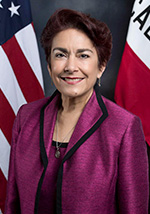
Anna Caballero’s California career has included work as an attorney and service on the Salinas Planning Commission, City Council and in the mayor’s office. She represented striking farm workers, worked alongside unions seeking to prevent plant closures and helped establish a firm offering low-cost legal service. Her state career has included two periods in the Assembly, an appointment by Gov. Jerry Brown and a Senate contest she lost before returning to win the seat eight years later. Her work has involved workers, legal access, libraries, literacy and community services. In May 2025, she launched a campaign for state treasurer in 2026.
ROOTS AND THE JOB BEFORE THE JOB
Born April 18, 1955, in Arizona, Caballero comes from a family of copper miners. She earned a bachelor’s degree from the University of California, San Diego, and a law degree from the UCLA School of Law. She moved to the Salinas Valley to work for California Rural Legal Assistance.
Her legal work included representing striking farm workers and fighting alongside unions to prevent plant closures. In 1982, she founded Caballero, Matcham & McCarthy with three partners. Its stated purpose was to provide low-cost legal service. She was recognized with the Athena Award for entrepreneurial excellence.
Caballero also served as executive director of Partners for Peace, a nonprofit dedicated to bringing the community together to prevent gang violence, focus on literacy and early childhood education, and provide services to families. She is a wife and mother. Her husband, Juan Uranga, is director of the Center for Community Advocacy in Salinas. Her professional record includes legal aid, a law firm, a community nonprofit, municipal government and state government.
THE PATH TO THE SENATE
Caballero served on the Planning Commission before Salinas voters elected her to the City Council in 1991 and mayor in 1998. As mayor, she navigated the city through budgetary problems and saved Salinas’s libraries, according to the Los Angeles Times.
She was elected to the California State Assembly in 2006 and represented the 28th Assembly District through 2010. That year, she ran for the state Senate and lost to Republican Anthony Cannella. Brown appointed her to lead the California State and Consumer Services Agency on March 22, 2011. She served until 2015.
Caballero returned to electoral office in 2016, winning another Assembly seat. In 2018, she again sought the state Senate, this time to succeed the term-limited Cannella. She won by defeating Republican Rob Poythress. Her path to the Senate included service on the Planning Commission and City Council, election as mayor, two periods in the Assembly, a Senate loss and leadership of the State and Consumer Services Agency.
THE THROUGH LINE
Caballero’s record spans several institutions and constituencies: striking farm workers needing representation, unions seeking to prevent plant closures, clients seeking low-cost legal service, library users during municipal budget problems, and Partners for Peace’s work focusing on literacy and early childhood education and providing services to families.
The form of her work has varied. As a lawyer, she represented striking farm workers and worked alongside unions. Through Caballero, Matcham & McCarthy, she helped provide low-cost legal service. In Salinas government, she served on the Planning Commission and City Council before becoming mayor. At the state level, she moved between the Legislature and the State and Consumer Services Agency.
Her documented record includes work involving workers, legal access, libraries, literacy, early childhood education and services for families. It also spans legal advocacy, local government, a state agency and legislative office. In May 2025, she officially launched her campaign for a statewide post, the 2026 California state treasurer election.
- State Senate · Senate District 14 · 2022–present
- State Senate · Senate District 12 · 2018–
- State Assembly · Assembly District 30 · 2016–
- State Assembly · Assembly District 28 · 2006–
Anna Caballero’s California career has included work as an attorney and service on the Salinas Planning Commission, City Council and in the mayor’s office. She represented striking farm workers, worked alongside unions seeking to prevent plant closures and helped establish a firm offering low-cost legal service. Her state career has included two periods in the Assembly, an appointment by Gov. Jerry Brown and a Senate contest she lost before returning to win the seat eight years later. Her work has involved workers, legal access, libraries, literacy and community services. In May 2025, she launched a campaign for state treasurer in 2026.
ROOTS AND THE JOB BEFORE THE JOB
Born April 18, 1955, in Arizona, Caballero comes from a family of copper miners. She earned a bachelor’s degree from the University of California, San Diego, and a law degree from the UCLA School of Law. She moved to the Salinas Valley to work for California Rural Legal Assistance.
Her legal work included representing striking farm workers and fighting alongside unions to prevent plant closures. In 1982, she founded Caballero, Matcham & McCarthy with three partners. Its stated purpose was to provide low-cost legal service. She was recognized with the Athena Award for entrepreneurial excellence.
Caballero also served as executive director of Partners for Peace, a nonprofit dedicated to bringing the community together to prevent gang violence, focus on literacy and early childhood education, and provide services to families. She is a wife and mother. Her husband, Juan Uranga, is director of the Center for Community Advocacy in Salinas. Her professional record includes legal aid, a law firm, a community nonprofit, municipal government and state government.
THE PATH TO THE SENATE
Caballero served on the Planning Commission before Salinas voters elected her to the City Council in 1991 and mayor in 1998. As mayor, she navigated the city through budgetary problems and saved Salinas’s libraries, according to the Los Angeles Times.
She was elected to the California State Assembly in 2006 and represented the 28th Assembly District through 2010. That year, she ran for the state Senate and lost to Republican Anthony Cannella. Brown appointed her to lead the California State and Consumer Services Agency on March 22, 2011. She served until 2015.
Caballero returned to electoral office in 2016, winning another Assembly seat. In 2018, she again sought the state Senate, this time to succeed the term-limited Cannella. She won by defeating Republican Rob Poythress. Her path to the Senate included service on the Planning Commission and City Council, election as mayor, two periods in the Assembly, a Senate loss and leadership of the State and Consumer Services Agency.
THE THROUGH LINE
Caballero’s record spans several institutions and constituencies: striking farm workers needing representation, unions seeking to prevent plant closures, clients seeking low-cost legal service, library users during municipal budget problems, and Partners for Peace’s work focusing on literacy and early childhood education and providing services to families.
The form of her work has varied. As a lawyer, she represented striking farm workers and worked alongside unions. Through Caballero, Matcham & McCarthy, she helped provide low-cost legal service. In Salinas government, she served on the Planning Commission and City Council before becoming mayor. At the state level, she moved between the Legislature and the State and Consumer Services Agency.
Her documented record includes work involving workers, legal access, libraries, literacy, early childhood education and services for families. It also spans legal advocacy, local government, a state agency and legislative office. In May 2025, she officially launched her campaign for a statewide post, the 2026 California state treasurer election.
The record
6,857 events, each with its sourceAssembly 3rd Reading AB2664 Bauer-Kahan et al. By Becker
Assembly 3rd Reading AB2664 Bauer-Kahan et al. By Becker Reconsider
Assembly 3rd Reading AB2664 Bauer-Kahan et al. By Becker
Assembly 3rd Reading AB2689 Ávila Farías et al. By Caballero
Assembly 3rd Reading AB2713 Wicks et al. By Becker
Assembly 3rd Reading AB2779 Irwin By Allen Urgency Clause
Assembly 3rd Reading AB2782 JUD. (Kalra) By Umberg
Assembly 3rd Reading ACA7 Jackson et al. By Weber Pierson
Special Consent SB96 Umberg
Unfinished Business SB239 Arreguín Concurrence
Unfinished Business SB299 Cabaldon et al. Concurrence
That the Assembly amendments be concurred in
That the Assembly amendments be concurred in
Unfinished Business SB490 Umberg et al. Concurrence
Special Consent SB505 Richardson
That the Assembly amendments be concurred in
Unfinished Business SB549 Allen et al. Concurrence
Unfinished Business SB594 Padilla et al. Concurrence
Unfinished Business SB667 Archuleta Concurrence
Unfinished Business SB700 Grayson Concurrence
Unfinished Business SB747 Wiener et al. Urgency Clause Concurrence
Unfinished Business SB758 Umberg et al. Concurrence
Unfinished Business SB769 Caballero et al. Concurrence
Unfinished Business SB772 Cabaldon et al. Concurrence
Unfinished Business SB802 Ashby et al. Concurrence
Special Consent SB837 Reyes
Special Consent SB845 Pérez et al
Unfinished Business SB849 Weber Pierson et al. Concurrence
Unfinished Business SB894 Allen et al. Concurrence
Unfinished Business SB913 Becker et al. Concurrence
Special Consent SB916 Ashby
Unfinished Business SB920 Archuleta Concurrence
Unfinished Business SB923 Becker Concurrence
Special Consent SB936 Blakespear et al
That the Assembly amendments be concurred in
Special Consent SB955 Blakespear et al. Urgency Clause
Unfinished Business SB959 Grayson et al. Urgency Clause Concurrence
Special Consent SB965 Blakespear et al
Special Consent SB971 Choi et al
Special Consent SB973 Becker et al
Special Consent SB974 Seyarto
Unfinished Business SB983 Weber Pierson Concurrence
Special Consent SB993 Ochoa Bogh et al
Unfinished Business SB996 Padilla et al. Concurrence
Unfinished Business SB1000 Becker Urgency Clause Concurrence
Unfinished Business SB1004 Wiener et al. Concurrence
Special Consent SB1017 Reyes et al
Unfinished Business SB1024 Menjivar et al. Concurrence
Special Consent SB1047 Niello et al
Unfinished Business SB1048 Becker et al. Concurrence