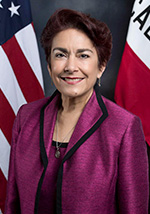
Anna Caballero’s California career has included work as an attorney and service on the Salinas Planning Commission, City Council and in the mayor’s office. She represented striking farm workers, worked alongside unions seeking to prevent plant closures and helped establish a firm offering low-cost legal service. Her state career has included two periods in the Assembly, an appointment by Gov. Jerry Brown and a Senate contest she lost before returning to win the seat eight years later. Her work has involved workers, legal access, libraries, literacy and community services. In May 2025, she launched a campaign for state treasurer in 2026.
ROOTS AND THE JOB BEFORE THE JOB
Born April 18, 1955, in Arizona, Caballero comes from a family of copper miners. She earned a bachelor’s degree from the University of California, San Diego, and a law degree from the UCLA School of Law. She moved to the Salinas Valley to work for California Rural Legal Assistance.
Her legal work included representing striking farm workers and fighting alongside unions to prevent plant closures. In 1982, she founded Caballero, Matcham & McCarthy with three partners. Its stated purpose was to provide low-cost legal service. She was recognized with the Athena Award for entrepreneurial excellence.
Caballero also served as executive director of Partners for Peace, a nonprofit dedicated to bringing the community together to prevent gang violence, focus on literacy and early childhood education, and provide services to families. She is a wife and mother. Her husband, Juan Uranga, is director of the Center for Community Advocacy in Salinas. Her professional record includes legal aid, a law firm, a community nonprofit, municipal government and state government.
THE PATH TO THE SENATE
Caballero served on the Planning Commission before Salinas voters elected her to the City Council in 1991 and mayor in 1998. As mayor, she navigated the city through budgetary problems and saved Salinas’s libraries, according to the Los Angeles Times.
She was elected to the California State Assembly in 2006 and represented the 28th Assembly District through 2010. That year, she ran for the state Senate and lost to Republican Anthony Cannella. Brown appointed her to lead the California State and Consumer Services Agency on March 22, 2011. She served until 2015.
Caballero returned to electoral office in 2016, winning another Assembly seat. In 2018, she again sought the state Senate, this time to succeed the term-limited Cannella. She won by defeating Republican Rob Poythress. Her path to the Senate included service on the Planning Commission and City Council, election as mayor, two periods in the Assembly, a Senate loss and leadership of the State and Consumer Services Agency.
THE THROUGH LINE
Caballero’s record spans several institutions and constituencies: striking farm workers needing representation, unions seeking to prevent plant closures, clients seeking low-cost legal service, library users during municipal budget problems, and Partners for Peace’s work focusing on literacy and early childhood education and providing services to families.
The form of her work has varied. As a lawyer, she represented striking farm workers and worked alongside unions. Through Caballero, Matcham & McCarthy, she helped provide low-cost legal service. In Salinas government, she served on the Planning Commission and City Council before becoming mayor. At the state level, she moved between the Legislature and the State and Consumer Services Agency.
Her documented record includes work involving workers, legal access, libraries, literacy, early childhood education and services for families. It also spans legal advocacy, local government, a state agency and legislative office. In May 2025, she officially launched her campaign for a statewide post, the 2026 California state treasurer election.
- State Senate · Senate District 14 · 2022–present
- State Senate · Senate District 12 · 2018–
- State Assembly · Assembly District 30 · 2016–
- State Assembly · Assembly District 28 · 2006–
Anna Caballero’s California career has included work as an attorney and service on the Salinas Planning Commission, City Council and in the mayor’s office. She represented striking farm workers, worked alongside unions seeking to prevent plant closures and helped establish a firm offering low-cost legal service. Her state career has included two periods in the Assembly, an appointment by Gov. Jerry Brown and a Senate contest she lost before returning to win the seat eight years later. Her work has involved workers, legal access, libraries, literacy and community services. In May 2025, she launched a campaign for state treasurer in 2026.
ROOTS AND THE JOB BEFORE THE JOB
Born April 18, 1955, in Arizona, Caballero comes from a family of copper miners. She earned a bachelor’s degree from the University of California, San Diego, and a law degree from the UCLA School of Law. She moved to the Salinas Valley to work for California Rural Legal Assistance.
Her legal work included representing striking farm workers and fighting alongside unions to prevent plant closures. In 1982, she founded Caballero, Matcham & McCarthy with three partners. Its stated purpose was to provide low-cost legal service. She was recognized with the Athena Award for entrepreneurial excellence.
Caballero also served as executive director of Partners for Peace, a nonprofit dedicated to bringing the community together to prevent gang violence, focus on literacy and early childhood education, and provide services to families. She is a wife and mother. Her husband, Juan Uranga, is director of the Center for Community Advocacy in Salinas. Her professional record includes legal aid, a law firm, a community nonprofit, municipal government and state government.
THE PATH TO THE SENATE
Caballero served on the Planning Commission before Salinas voters elected her to the City Council in 1991 and mayor in 1998. As mayor, she navigated the city through budgetary problems and saved Salinas’s libraries, according to the Los Angeles Times.
She was elected to the California State Assembly in 2006 and represented the 28th Assembly District through 2010. That year, she ran for the state Senate and lost to Republican Anthony Cannella. Brown appointed her to lead the California State and Consumer Services Agency on March 22, 2011. She served until 2015.
Caballero returned to electoral office in 2016, winning another Assembly seat. In 2018, she again sought the state Senate, this time to succeed the term-limited Cannella. She won by defeating Republican Rob Poythress. Her path to the Senate included service on the Planning Commission and City Council, election as mayor, two periods in the Assembly, a Senate loss and leadership of the State and Consumer Services Agency.
THE THROUGH LINE
Caballero’s record spans several institutions and constituencies: striking farm workers needing representation, unions seeking to prevent plant closures, clients seeking low-cost legal service, library users during municipal budget problems, and Partners for Peace’s work focusing on literacy and early childhood education and providing services to families.
The form of her work has varied. As a lawyer, she represented striking farm workers and worked alongside unions. Through Caballero, Matcham & McCarthy, she helped provide low-cost legal service. In Salinas government, she served on the Planning Commission and City Council before becoming mayor. At the state level, she moved between the Legislature and the State and Consumer Services Agency.
Her documented record includes work involving workers, legal access, libraries, literacy, early childhood education and services for families. It also spans legal advocacy, local government, a state agency and legislative office. In May 2025, she officially launched her campaign for a statewide post, the 2026 California state treasurer election.
The record
167 events, each with its sourceSuicide Prevention Awareness Month.
Arts, Culture, and Creativity Month.
American Muslim Appreciation and Awareness Month.
Relative to Women’s Equal Pay Day.
Relative to California Agriculture Day.
Relative to Cinco de Mayo Week.
Criminal procedure: discrimination.
Civil rights: deprivation of federal constitutional rights, privileges, and immunities.
Transportation: climate resiliency: projects of statewide and regional significance.
Transit-oriented housing development: excluded parcels and sites.
Relative to California Human Milk Donation Month.
The Golden State Infrastructure Corporation Act.
Personal income tax: credit: durable medical equipment.
Civil Actions: writs: housing development projects.
Hazardous materials: metal shredding facilities.
Greenhouse gases: Greenhouse Gas Reduction Fund: studies.
Relative to National Drunk and Drugged Driving Awareness Month.
California Environmental Quality Act: judicial streamlining: state of emergency: wildfire.
Workers’ compensation: average annual earnings.
Employment: immigration and work authorization.
Food vendors and facilities: enforcement activities.
Nonminor dependents: tax guidance.
Housing developments: disasters: reconstruction of destroyed or damaged structures.
Atmospheric rivers: research: forecasting methods: experimental tools.
Rural hospitals: standby perinatal services.
Winter Fires of 2025: real property tax: exemptions and reassessment.
Carbon Dioxide Removal Purchase Program.
Relative to Teen Dating Violence Awareness and Prevention Month.
Drinking water: primary standard for hexavalent chromium: exemption.
Office of Emergency Services: training: transnational repression.
Nurse-midwifery education program.
High-speed rail: third-party agreements, permits, and approvals: regulations.
The Veterans and Affordable Housing Bond Act of 2026.
Hazardous materials: metal shredding facilities.
Student Aid Commission: California Dream Act application.
Relative to President Jimmy Carter Day.
Peripartum Cardiomyopathy Awareness Month.
State Energy Resources Conservation and Development Commission: seaports: plan: alternative fuels.
Relative to the “2-1-1” information and referral service.
Pleas: immigration advisement.